Business9 min read
Roofing Branding: How to Make Every Truck, Sign, and Page Match
Roofing branding is one name, one look, and one promise on every truck, sign, card, website, and Google profile. How to set it up and check it in an afternoon.

In this article
Roofing branding isn’t the logo. It’s whether a homeowner recognizes the same company every time they run into you: the truck in a neighbor’s driveway, the yard sign on the corner, the Google profile they pull up that night, the website, and the estimate you leave on the kitchen table. When all of those match, each one reminds them of the others. When they don’t, you look like three different companies, and none of them sticks.
Most roofing companies don’t have a branding problem so much as a drift problem. The logo got redrawn for the new trucks, the website still has the old one, the Google profile has a longer name somebody typed in years ago, and the shirts are a slightly different red. Nobody decided that. It just happened, one print order at a time.
The short answer
Roofing branding means using one name, one logo, the same two or three colors, and the same short promise everywhere a homeowner sees you. Write those down on a one-page brand sheet, make your website and Google Business Profile match it exactly, and bring trucks, signs, shirts, and paperwork in line as you replace them. Check your name against the USPTO’s trademark database before you print anything new.
What roofing branding actually covers
A brand is the sum of the small things people notice. For a roofing company, that list is shorter than branding agencies make it sound:
- The name, written the same way every time
- The logo, in a full version and a small square version
- Two or three colors, with exact codes so every shop prints the same shade
- One font family for headings and one for everything else
- A short promise or slogan that says what you actually do well
- A way of talking: how you answer the phone, reply to reviews, and write a post
- A photo style: real job photos, shot the same way, in good light
Then there’s everywhere those things show up, from the trucks and shirts to the website, Google, and the voicemail greeting. Branding is making all of it agree.
Why matching matters on Google, too
Consistency isn’t only about looks. Google’s own rules for business profiles lean on it.
Google’s guidelines for representing your business (opens in a new tab) say your profile name “should reflect your business’s real-world name, as used consistently on your storefront, website, stationery, and as known to customers.” The same page tells businesses to represent themselves “as it’s consistently represented and recognized in the real world across signage, stationery, and other branding.”
So your trucks, signs, and paperwork are part of how Google expects you to name yourself online.
Google’s name rules
Google’s guidelines don’t allow marketing taglines, phone numbers, website addresses, or service and location details in the business name, and adding unnecessary information “could result in the suspension of your Business Profile.” Legal terms like LLC and special characters need real-world proof, such as signage, business cards, or invoices that show them as part of the name. Keep the slogan and the service list out of the name field.
Google also says that businesses with complete and accurate info (opens in a new tab) are more likely to show up in local search results. A profile that matches your website and your signs is easier to keep accurate, because there’s only one version of the truth to maintain.
How to build a roofing brand that matches everywhere
You don’t need a rebrand. Most of the work is writing down what you already use.
1. Settle the name once
Start with the name, because everything else hangs on it. The SBA’s guide to choosing your business name (opens in a new tab) explains that there are four separate ways a name gets registered: the legal entity name with your state, a trademark at the federal level, a “doing business as” (DBA) name, and your domain name. It notes that these are legally independent, and that most small businesses try to use the same name for each.
For a roofer, the trouble usually starts when those split apart. The LLC is one name, the trucks say a shorter one, and the website domain is a third version picked because the first two were taken. Decide which name homeowners should know you by, register a DBA if your state requires one for it, and use that exact name everywhere customers see you. Our guide to roofing company names covers the checks to run before you commit.
2. Write a one-page brand sheet
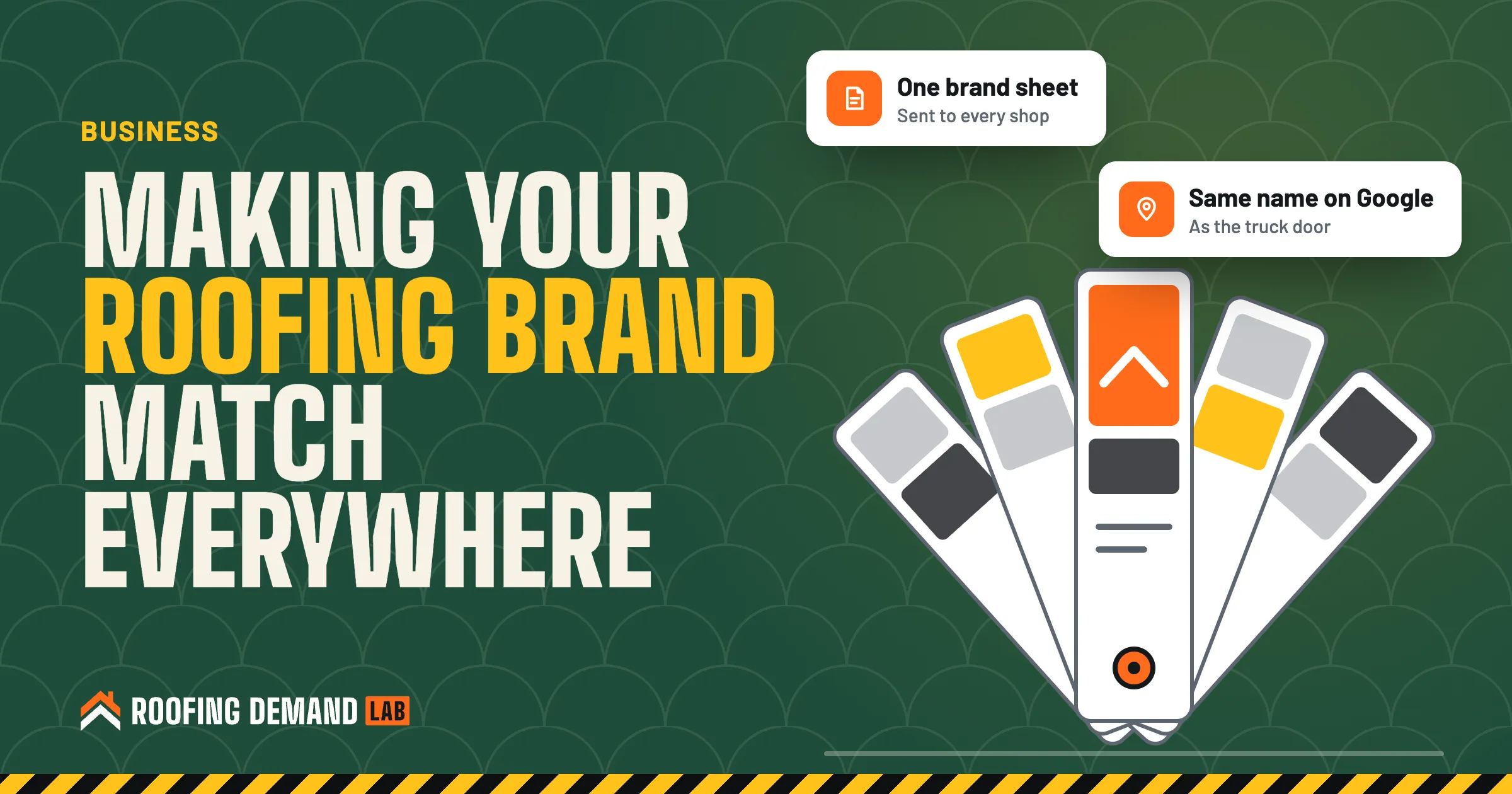
This is the piece most roofing companies skip, and it’s the one that stops the drift. One page, saved as a PDF, sent to every sign shop, printer, web designer, and embroiderer you hire.
| What goes on the sheet | What to write down |
|---|---|
| Name | The exact spelling and capitalization, and whether “Roofing” or “Roofing & Gutters” is part of it |
| Logo files | Where the full logo and the square version live, in vector and PNG |
| Colors | A web code (hex) for each color, plus a print match your sign and wrap shop can use |
| Fonts | One heading font and one body font |
| Promise | Your slogan or one-line promise, word for word |
| Contact line | The one phone number and web address you want printed, written the same way each time |
| License line | How your license number appears, where your state or city requires it |
| Photos | Real job photos only, and how you want them shot |
When a shop asks “what red is it?”, you send the sheet. When a new office manager makes a flyer, they start from the sheet. That’s the whole system.
3. Check the trademark before you print more
A name and logo you’ve used for years can still run into someone else’s. The USPTO explains that a trademark (opens in a new tab) can be any word, phrase, symbol, or design that identifies your services, and that rights attach to how a mark is used with specific goods or services, not to a word in general. Registering is optional. The USPTO lists the benefits of federal registration (opens in a new tab), including a legal presumption that you own the mark and the right to use the ® symbol. Don’t put ® on the trucks until the registration is granted. Our roofing logos guide covers what to check before you lock in a design.
Get advice on legal questions
Trademark searches and registrations can get complicated, and state rules on business names and DBAs vary. This guide is general information only. Check with your state’s business registration office and talk to a trademark attorney before you rename, register, or rebrand.
4. Match the Google Business Profile to the real-world name
Open your Google Business Profile and compare it with your truck door. Same name? Same logo? Same phone number? If the profile says something longer, like a name with a city and a service tacked on, it’s out of line with Google’s guidelines and with the rest of your brand.
While you’re in there, use the square logo and add recent job photos. Our Google Business Profile guide for roofers walks through the rest of the settings.
5. Make the website the master copy
Your website is the one place you control completely, so treat it as the reference version of your brand: same logo, colors, name, phone number, slogan, and service area as everywhere else.
It’s often where homeowners land after they see a truck or a sign, and an old logo there makes them wonder if they found the right company. If yours needs a rebuild, our roofing website design page shows what we put on every site we build, and how to build a roofing website covers the basics if you’re doing it yourself.
6. Bring trucks, signs, and paper in line as you replace them
You don’t have to rewrap the fleet next week. Make a list of everything with your name on it and fix each item as it comes up for replacement:
- Trucks and trailers: next wrap or next new vehicle. Our roofing truck wraps guide covers what to put on them.
- Yard signs: next print run. See roofing yard signs.
- Business cards and estimate forms: next box. See roofing business cards.
- Shirts and hats: next order, with the embroiderer working from the brand sheet.
The goal is that a year from now, nothing with your name on it predates the brand sheet.
7. Keep the voice the same online
Branding is also how you sound. If the trucks say you’re the careful, tidy crew, your Facebook posts, review replies, and emails should sound careful and tidy too. The roofing slogans guide helps you put that promise into a line, and the roofing social media guide covers what to post.
A brand check you can run this afternoon
Pull up each of these side by side and look for anything that doesn’t match the brand sheet:
| Where | What to check |
|---|---|
| Google Business Profile | Name, logo, phone number, website link, service area |
| Website | Logo, colors, name in header and footer, phone number, slogan |
| Facebook and Instagram | Profile picture, cover image, page name, contact info |
| Trucks and trailers | Logo version, colors, phone number, web address |
| Yard signs | Same as the trucks, plus the license line if required |
| Estimates and invoices | Logo, name, contact line |
| Business cards | Name, title, contact line, logo |
| Email signature and voicemail | Name said or written the same way |
Write down every mismatch, then fix the free ones today (the website, Google, social profiles, email signatures) and put the printed ones on the replacement list.
What branding can’t do on its own
A matching brand helps people recognize you and remember you. It doesn’t replace good work or a steady stream of reviews. Google says local results are based mainly on relevance, distance, and prominence, and that prominence draws on things like how many websites link to your business and how many reviews you have (Google on local ranking (opens in a new tab)).
Think of branding as what ties the rest together. A homeowner who saw your truck last week and your yard sign this morning has a better chance of recognizing your name on the map tonight. That only works if all three look like the same company. For the reviews side, our roofing reviews guide covers how to ask without breaking Google’s rules, and roofing SEO is how we keep that profile and site visible in the towns you serve.
Questions about roofing branding
How do I brand a roofing company?
Pick one name, one logo, two or three colors, and a short promise, and write them on a one-page brand sheet. Make your website and Google Business Profile match that sheet first, since they’re free to change. Then update trucks, signs, shirts, and paperwork as each one comes up for replacement.
What colors are best for a roofing company?
There’s no single best color. Pick two or three that contrast well, so your name reads clearly on a white truck, a yard sign, and a small phone screen. It also helps to choose colors other roofers in your area aren’t already using, so your trucks don’t blend in with theirs.
Do I need to trademark my roofing company name?
Federal registration is optional. The USPTO lists benefits such as a legal presumption of ownership and the right to use the ® symbol, which you can only use once the registration is granted. At minimum, search the USPTO’s database before you invest in signs and wraps, and talk to a trademark attorney if you find a similar name.
Should my Google Business Profile name include keywords like “roofing” and my city?
Only if they’re part of your real name. Google’s guidelines say the profile name should match the name you use on your signs, website, and stationery, and they don’t allow added service or location details. Put your services, categories, and service area in the fields Google provides for them instead.