Social media9 min read
Roofing Social Media Posts: What to Share and What to Skip
Roofing social media posts that earn trust: what to share from real jobs, the FTC, OSHA, and FAA rules behind the photos, and the posts roofers should skip.

In this article
Good roofing social media is mostly a record of real work: the roof before, the roof after, the crew doing it safely, and plain answers to the questions homeowners ask at the kitchen table. That’s it. You don’t need dance trends, daily motivational quotes, or a content calendar with a theme for every day of the week. You need proof that your company exists, does good work, and shows up.
Most homeowners won’t hire a roofer off one post. What they will do is look you up after they see your truck, your yard sign, or your name in a neighbor’s recommendation. Your Facebook Page and Instagram are where they check whether you’re real. A page with last month’s job photos passes that check. A page whose last post was a holiday greeting from two years ago doesn’t.
The short answer
Post your own job photos (with the homeowner’s OK), short job-site videos, your crew working safely, real reviews, and quick answers to common roof questions. Skip stock photos passed off as your work, bought followers, review giveaways, house numbers and addresses, and anything that pitches insurance claims. Post on a schedule you can actually keep, even if that’s once a week.
Where roofers should post
Start with two places and do them well:
- A Facebook Page, because it’s a common place for homeowners to check a local business after they hear its name, and to ask neighbors for a recommendation.
- Instagram, because the same job photos and short videos work there with almost no extra effort.
Then reuse the same photos on your Google Business Profile, which isn’t social media but is often the first thing a homeowner sees when they search your name. If you do commercial work, a LinkedIn company page is worth adding, since many property managers and facility directors use it for work.
One good page beats five empty ones. If you can’t keep a platform active, leave it off your website and business cards until you can.
What to post on roofing social media
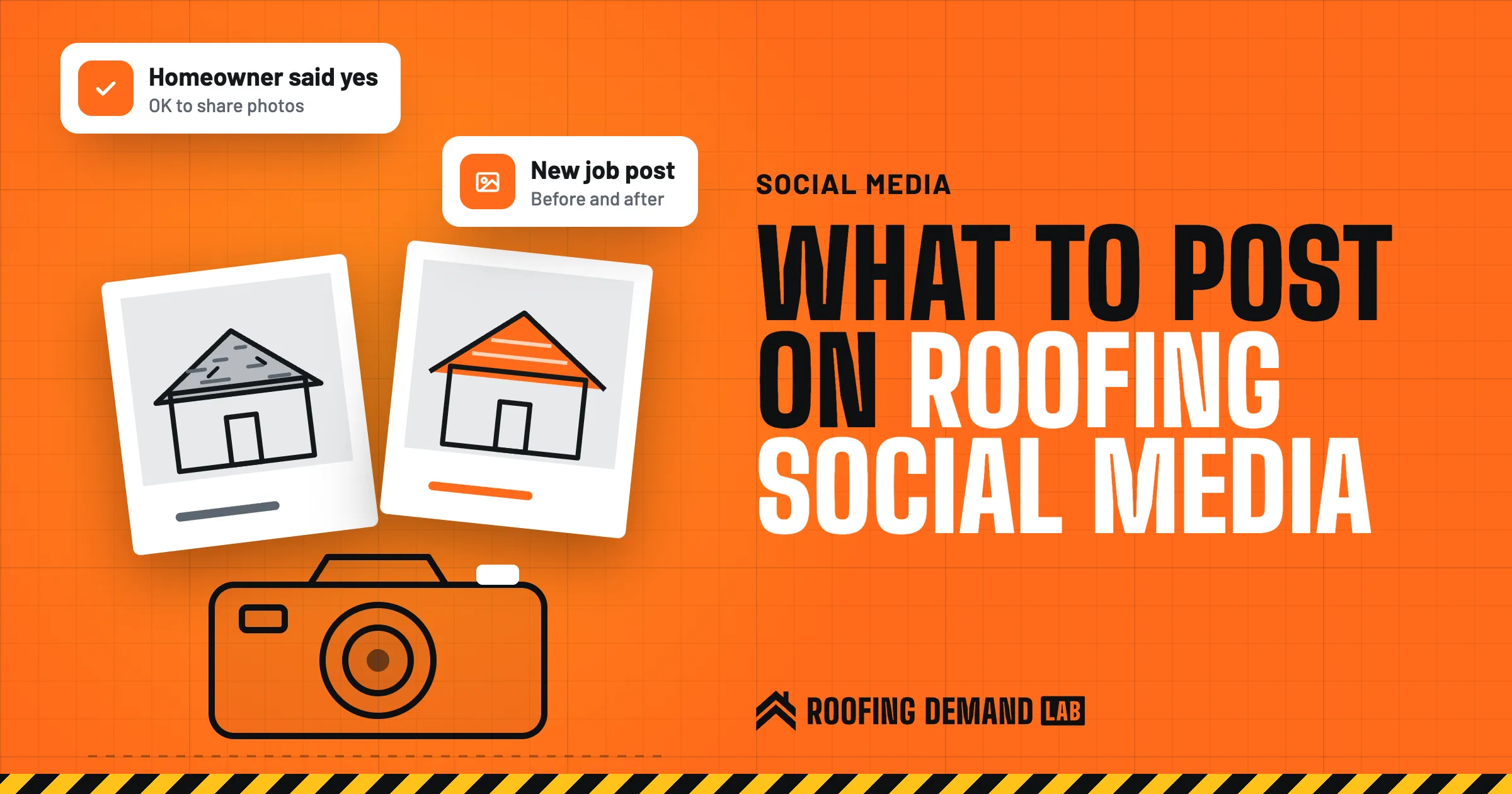
1. Before-and-after photos from real jobs
This is the backbone of roofing social media posts. A tired, curling roof next to a clean new one tells the whole story without a caption.
Take the “before” shot on every job, from the same angle you’ll use for the “after.” Get the homeowner’s OK before you post photos of their house, and keep house numbers, license plates, and anything else that pins down the address out of the frame. A good caption names the town, the job type, and one detail worth knowing (“Full tear-off in Broken Arrow. We found soft decking along the back edge and replaced it before the new shingles went on.”).
2. Short videos from the job site
Fifteen to thirty seconds of a crew loading the dumpster, rolling out underlayment, or setting the ridge cap shows the work better than any graphic. Shoot it vertical on a phone. Keep the camera steady and the clip short.
Drone rules
Drone shots look great on a finished roof, but flying for your business is covered by federal rules. The FAA says that if your drone is under 55 pounds, “you can fly for work or business by following the Part 107 guidelines,” and its steps include passing a knowledge test to get a Remote Pilot Certificate (FAA guidance for certified remote pilots (opens in a new tab)). Whoever flies the drone for your company should have that certificate before the footage goes online. Check local rules on flying over neighbors’ property, too.
3. Your crew, working safely
People hire people. Photos of your crew on the job, the owner walking a roof with a homeowner, or the office team loading a trailer make a company feel less anonymous.
Look at every photo before it goes up. A picture of a crew on a steep roof with no fall protection is a public record of a safety problem. OSHA requires fall protection at “six feet in the construction industry” (OSHA fall protection (opens in a new tab)). If a shot shows someone without the harness or other protection the job calls for, don’t post it. Fix the habit, then take the photo.
4. Answers to the questions you hear on every estimate
Every roofer gets the same questions: how long does a tear-off take, what’s the difference between a repair and a replacement, why does the inspection include the attic, what happens if it rains mid-job. Each one is a post. Snap a photo of the thing you’re explaining (a cracked boot around a vent pipe, granules in a gutter) and answer the question in three or four sentences.
These posts give homeowners a reason to follow you before they need a roofer, and they’re the easiest to write because you already say the answers out loud every week. Our post on roofing keywords lists the searches homeowners make, which doubles as a list of post ideas.
5. Storm updates that inform, not alarm
After real weather moves through, a post can help: where your crews are working, how to spot damage from the ground, what to photograph before calling anyone. Keep it calm and factual.
Insurance advertising rules
Be careful the moment a post mentions insurance. Florida’s statute defines a “prohibited advertisement” as “any written or electronic communication by a contractor” that encourages a consumer to contact a contractor or public adjuster to make an insurance claim for roof damage, unless it includes specific disclosures about the deductible and insurance fraud (Florida Statutes section 489.147 (opens in a new tab)). Other states have their own rules. Don’t promise that insurance will pay, and check your state’s rules or ask a licensed attorney before any post talks about claims or deductibles.
6. Real reviews, shared the honest way
A screenshot of a real Google review, with the reviewer’s first name, makes a good post. Ask the customer first if you’ll add their photo or their full name.
The FTC’s staff guidance on its reviews and testimonials rule says “a business that puts testimonials on its own website is disseminating them and is not merely ‘hosting’ them” (FTC reviews and testimonials rule Q&A (opens in a new tab)). Your Facebook Page is your own channel too, so treat what you post there the same way: if it’s fake or false, it’s your problem. Our guide to getting more Google reviews covers how to ask for them without breaking Google’s or the FTC’s rules.
7. The same photos, on your Google Business Profile
Every job photo you post to Facebook and Instagram can go on your Business Profile too. Google’s photo guidelines say a photo “should be in focus and well lit, and have no significant alterations or excessive use of filters,” and sum it up as “the image should represent reality” (Google’s Business Profile photo guidelines (opens in a new tab)).
If you write Business Profile posts, leave the phone number out of the text. Google says it “may remove posts with unverified contact information,” and suggests a Call now button instead (Google’s Business Profile posts policy (opens in a new tab)).
What to skip
Some posts cost more trust than they earn. Leave these off your pages:
- Stock photos passed off as your work. Homeowners notice when every roof on your page is a different style of house in a different climate. Use your own photos or none.
- Bought followers and likes. The FTC’s reviews and testimonials rule also covers fake social media indicators, including ones “generated by bots” or from “purported individual accounts not associated with a real individual.” FTC staff say buying them is a problem when you “knew or should have known” they were fake (FTC reviews and testimonials rule Q&A (opens in a new tab)). Eighty real local followers beat ten thousand fake ones anyway.
- Giveaways for good reviews. The FTC’s endorsement guidance says you can “invite all of your customers to post honest reviews, positive or negative,” but you “can’t condition an incentive” on the review being positive (FTC Endorsement Guides FAQ (opens in a new tab)). A “leave us five stars and get entered to win” post crosses that line.
- Employees cheering without saying who they are. If your sales reps post about the company or review it, the same FTC guidance says they “should disclose” the relationship, and that listing the employer on a profile page “isn’t enough.” Give your team a short social media policy that says so.
- Customer addresses and house numbers. Even with permission to post the house, keep the exact address off the internet.
- Insurance claim pitches. “We’ll get you a free roof from your insurance” is the kind of line that gets roofers in trouble. See the caution above.
- Boosted posts with promises about who they’ll reach. When you pay to boost a post, you’re running an ad. Meta says U.S. advertisers running housing ads “must self identify as a Special Ad Category” (Meta’s discriminatory practices policy (opens in a new tab)), and home-related ads can land in that category, which rules out ZIP-code targeting and requires a radius of at least 15 miles (Meta’s special ad category rules (opens in a new tab)). Our guide to Facebook ads for roofers explains how to work inside those rules.
A page with ten honest job posts says more about your company than a hundred stock graphics.
A posting rhythm you can keep
The roofers who stick with social media don’t treat it as a separate job. They make it part of the job they’re already doing:
- Shoot on every job Before, during, after, from the same angles. Make it part of the crew lead’s checklist, right next to the final cleanup.
- Get the OK in writing Add a line to your contract or job paperwork asking whether you can share photos of the project, with no address shown.
- Post once or twice a week One job post and one question-and-answer post is plenty. Consistency matters more than volume.
- Answer comments and messages A question left unanswered on your page looks worse than no page. If you plan to text someone back, get their consent first: FCC rules require consent for autodialed or prerecorded calls and texts to cell phones, and commercial texts require written consent (FCC guide to robocalls and texts (opens in a new tab)).
- Look back once a month Which posts got comments, shares, and messages? Do more of those.
An honest note
Social media can help homeowners recognize and trust your company, but no one can promise a number of calls or jobs from it, us included. Treat it as the proof that backs up your website, your reviews, and your yard signs, not as a replacement for them.
If you’d rather hand it off, our digital marketing services include social posts built from your own jobs. The Growth plan includes 4 social media posts a month and Market Leader includes 8, and every plan comes with a roofing website.
Questions roofers ask about social media
What should a roofing company post on social media?
Post before-and-after photos from your own jobs, short job-site videos, your crew working safely, real reviews, and short answers to the questions homeowners ask during estimates. Get the homeowner’s permission before posting their house, and keep addresses out of the frame.
How do I advertise my roofing business on Instagram?
Start with an active profile full of your own job photos and short videos, since that’s what people check after they see an ad. If you pay to promote posts, Instagram ads run through Meta, so plan for its housing rules: no ZIP-code targeting and a minimum 15-mile radius. Our Facebook ads guide covers the setup.
Is social media worth it for roofers?
It’s worth doing at a level you can keep up. A page with recent, real job photos helps homeowners who look you up decide you’re legitimate. It works best alongside a solid website, a filled-out Google Business Profile, and steady reviews, not on its own.
How often should a roofer post on social media?
Once or twice a week is enough for most roofing companies. A steady weekly post from a real job does more than a burst of daily posts that stops after a month.