Lead generation9 min read
Roofing Truck Wraps: How to Design One People Read at 40 MPH
Roofing truck wraps get a few seconds of attention. What to put on yours, what to leave off, and the license and USDOT lettering rules to check first.

In this article
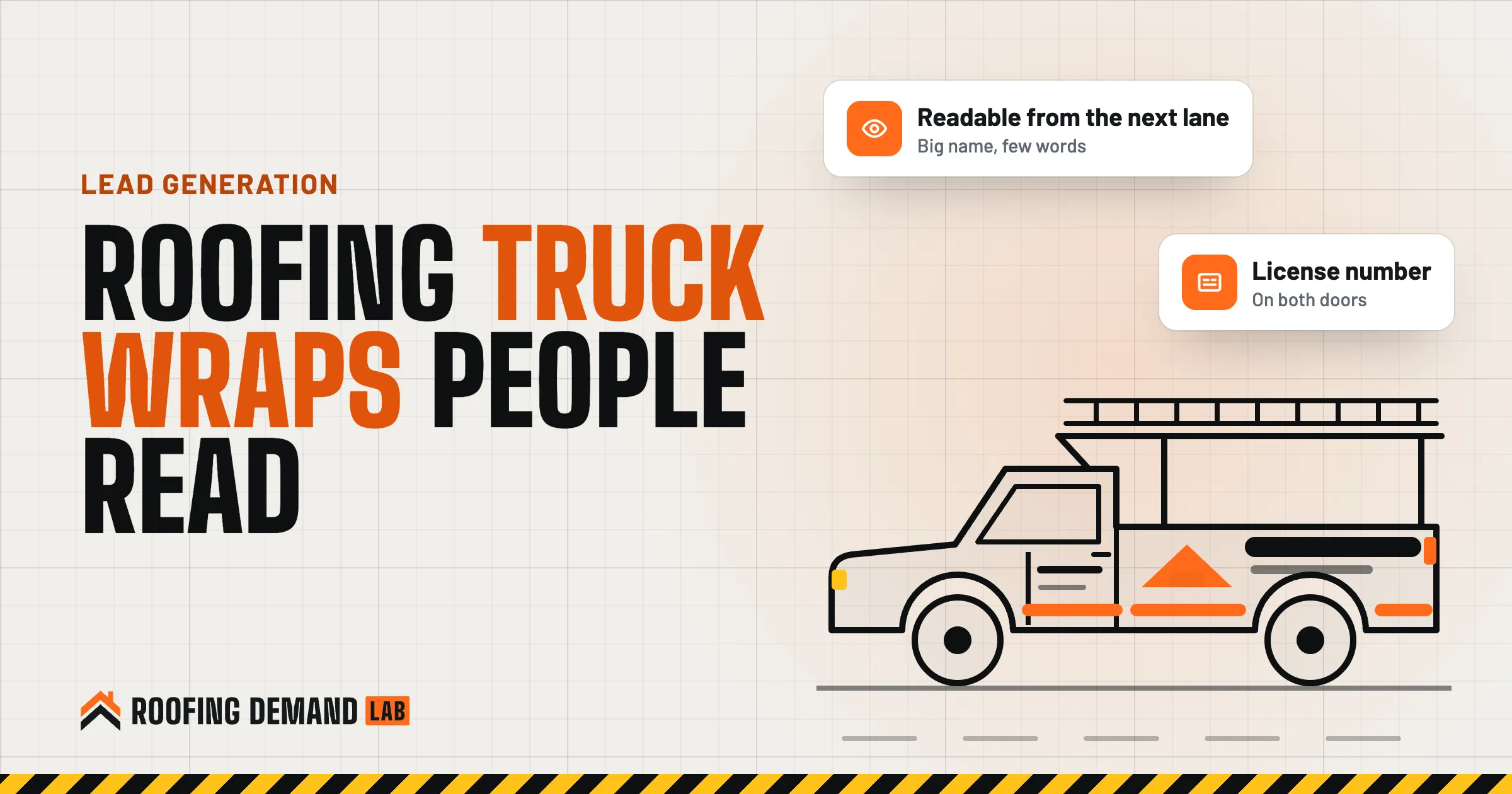
A roofing truck wrap gets read in pieces. Someone glances at it at a red light, again when you pass them on the highway, and maybe once more when your truck sits in a driveway on their street. Each look lasts a few seconds. The wrap that works says three things fast: who you are, that you do roofs, and how to find you. The wrap that fails is the one that tries to be a brochure on wheels.
It’s also one of the few marketing pieces with legal rules built in. Depending on your state and your truck, the lettering may need your license number or a USDOT number.
The short answer
Put your company name in the biggest letters on the truck, two or three words on what you do, one easy way to find you (a short web address or a name people can search), and your license number where your state requires it. Use high contrast, few words, and the tailgate for the longest look. Leave off long service lists, claims you can’t prove, and anything about insurance claims. Check your state licensing board and, for heavier trucks, the federal USDOT marking rule before you approve the design.
What a roofing truck wrap is for
A wrap won’t make the phone ring by itself. What it does well is repetition. Your trucks spend all day in the towns you serve, parked in front of the houses your future customers walk past. It works like a yard sign that moves: the sign tells one street who did the work, and the truck tells every street you drive down.
There are three common ways to letter a truck:
| Option | What it covers | Good when | Watch out for |
|---|---|---|---|
| Full wrap | The whole body, printed edge to edge | You want the truck itself to be the ad | Busy designs that bury the name |
| Partial wrap | Part of the body, blended into the paint color | You want a strong look for less vinyl | Making sure the graphics still read on the paint |
| Cut vinyl lettering | Name, services, and numbers only | You have several trucks or keep it simple | Letters too small to read past one car length |
What to put on a roofing truck wrap
1. Your company name, bigger than anything else
This is the one thing every glance should catch. Use the name exactly as it appears on your website and Google Business Profile, so a person who remembers “that orange truck” can find you. If your logo is hard to read from across the street, our guide to roofing logos covers how to fix that.
2. What you do, in two or three words
“Roofing” plus one or two specifics is enough: “Roof repair and replacement” or “Residential roofing.” Skip the list of eleven services. Nobody reads a list at 40 miles an hour, and a long list makes the name smaller.
3. One way to find you
Pick the one you want people to use. A short web address works well because it’s easy to remember and easy to track. If you print a phone number, make it one someone answers. Three contact methods on one door usually means none is big enough to read.
4. Your license number, where your state requires it
Check your state’s vehicle rules
California’s Contractors State License Board says your business name and contractor license number should be clearly visible on your commercially registered vehicle in print type of at least 72-point font, or three-quarters of an inch in height and width, and that civil penalties for breaking contractor advertising laws can range from $100 to $5,000 (CSLB industry bulletin on advertising on vehicles (opens in a new tab)). Florida requires a contractor’s registration or certification number in each advertisement, “regardless of medium” (Florida Statutes 489.119 (opens in a new tab)). Other states have their own rules. Ask your state licensing board what has to appear on your vehicles before the design is final.
Even where it isn’t required, a license number tells a careful homeowner you have nothing to hide.
5. A USDOT number, if the truck qualifies
Federal marking rule for heavier trucks
Under federal rules, a commercial motor vehicle includes one used in interstate commerce with a gross vehicle weight rating or gross combination weight rating of 10,001 pounds or more (49 CFR 390.5 (opens in a new tab)). If yours qualifies, the marking has to show your legal name or a single trade name and your USDOT number, appear on both sides, contrast sharply with the background, and be readily legible during daylight hours from 50 feet while the vehicle is stationary (49 CFR 390.21 (opens in a new tab)). A pickup towing a dump trailer full of tear-off can cross that weight line. This is general information. Check with your state’s transportation department or a compliance professional about your trucks, including ones that never leave the state.
Plan for it in the design instead of sticking a number on the door afterward.
6. One picture, and make it yours
A clean photo of a roof your crew installed, or a simple roof shape that echoes your logo. Skip stock photos, and never use another company’s job photos. One strong image is plenty.
How to make a wrap readable at a glance
For highway signs, the Federal Highway Administration describes the legibility criterion as about 30 feet of distance per inch of letter height (FHWA research on sign legibility (opens in a new tab)). A truck isn’t a highway sign, but it’s a useful rough guide: by that measure, 4-inch letters read from roughly 120 feet and 1-inch letters from about 30. So make the name big, the service line a step down, and save small print for things only someone standing close needs, like the license number.
A few more rules that hold up:
- High contrast wins. Dark letters on a light background, or light letters on dark. Orange on red, or gray on silver, disappears.
- Use a plain, bold font. Script and thin letters turn into a smudge from the next lane.
- Design for the back of the truck. The driver behind you at a light has the longest look of anyone. Put the name and the web address on the tailgate or rear doors.
- Check what the truck hides. Ladder racks, toolboxes, door handles, and wheel wells cut through graphics. Ask the installer for a mockup on a photo of your actual truck, not a flat template.
What to leave off the truck
Claims you can’t prove. The FTC says advertising must be truthful and non-deceptive, and that the law requires advertisers to have proof before the ad runs (FTC advertising FAQs for small business (opens in a new tab)). A truck is an ad. “Best roofer in the state” is a claim you’d have to back up. The same guide says endorsements must reflect the honest experience of the person giving them, so no made-up quotes or star ratings either.
“Bonded” in California. The same CSLB bulletin reminds contractors that, by law, they aren’t allowed to advertise that they are bonded. “Licensed, bonded, and insured” is a common truck line, so check it against your state’s rules before it goes on the door.
Slogans that need reading. If it takes more than a second to get, it belongs on your website. Our guide to roofing slogans covers the short kind.
Storm and insurance wording
Keep insurance claims off your trucks, wraps, and magnets. Florida’s law on prohibited advertisements covers written communications that encourage a homeowner to contact a contractor about a roof damage insurance claim, lists magnets, flyers, door hangers, and business cards as examples, and allows them only with specific disclosures, including that the homeowner is responsible for paying any deductible (Florida Statutes 489.147 (opens in a new tab)). Other states have their own rules. This is general information, not legal advice, so ask an attorney before anything about storms or claims goes on a vehicle.
What about a QR code?
Nobody can scan a code on a moving truck. A QR code can make sense on the tailgate for people walking past while the truck is parked at a job. If you add one, print the web address next to it. The FTC tells people to inspect the URL before they open a QR code link and to watch for spoofed addresses (FTC consumer alert on QR codes (opens in a new tab)). A visible address that matches your company name gives a cautious person a reason to trust the code.
How to tell if the wrap is doing anything
A wrap is hard to measure, but not impossible. Three simple ways:
- Give the truck its own web address A short address that forwards to a page on your site, tagged so it shows up in your reports. Google Analytics says you should always use utm_source, utm_medium, and utm_campaign when you add these tags (Google Analytics help on custom URLs (opens in a new tab)). Something like
utm_source=truck&utm_medium=vehicle&utm_campaign=truck-wrapkeeps it separate from everything else. - Ask every caller how they heard about you Write it down. “I saw your truck on my street” is an answer worth counting.
- Watch searches for your name If more people search your company name after the trucks go out, the wrap may be part of the reason.
When someone reaches out, answer fast and book the inspection. Before you add anyone to marketing texts, get their consent: FCC rules require a caller to get consent before an autodialed call or text to someone’s cell phone (FCC guide to unwanted calls and texts (opens in a new tab)).
Make the truck match everything else
A wrap sends people to search for you, and what they find decides whether they call. If the truck says one name and your Google Business Profile says another, the wrap did its job and the rest lost the inspection.
Use the same name, colors, and logo on the truck, the website, the yard signs, and your business cards, so every piece looks like the same company. Then make sure your name shows up well when someone searches it. That’s what our roofing SEO work is built for. For the full list of ways roofers bring in work, see how to get roofing leads.
An honest note
Nobody can promise a set number of calls from a truck wrap, us included. A readable truck can make your company easier to remember and easier to find, and that’s its job.
Questions roofers ask about truck wraps
How much does it cost to wrap a roofing truck?
It depends on the truck’s size, how much you cover, the film, and the design work, so prices vary by installer and market. Get written quotes from two or three local shops and compare what each includes. Cut vinyl lettering uses far less material than a full wrap, so price both.
How long does a truck wrap last?
That depends on the film, the installation, the climate, and how the truck is washed and parked. Ask the installer for the film manufacturer’s warranty and their own installation warranty in writing, along with their care instructions.
How do you design a truck wrap that people can read?
Make the company name the biggest thing on the truck, keep the rest to a service line and one way to find you, and use high contrast with a plain, bold font. Put the name and web address on the back, where drivers look longest, and ask for a mockup on a photo of your actual truck.
Do I have to put my license number on my truck?
In some states, yes. California’s contractor board says the business name and license number should be clearly visible on commercially registered vehicles in at least three-quarter-inch type, and Florida requires the license number on advertising regardless of medium. Check with your own state’s licensing board, and check the federal USDOT marking rule if your truck or truck-and-trailer combination is rated at 10,001 pounds or more and crosses state lines.