Business9 min read
Roofing Marketing Plan: A One-Page Plan Owners Can Actually Use
How to write a roofing marketing plan on one page: who you want, the channels you will use, a budget by channel, a seasonal calendar, and a monthly check.

In this article
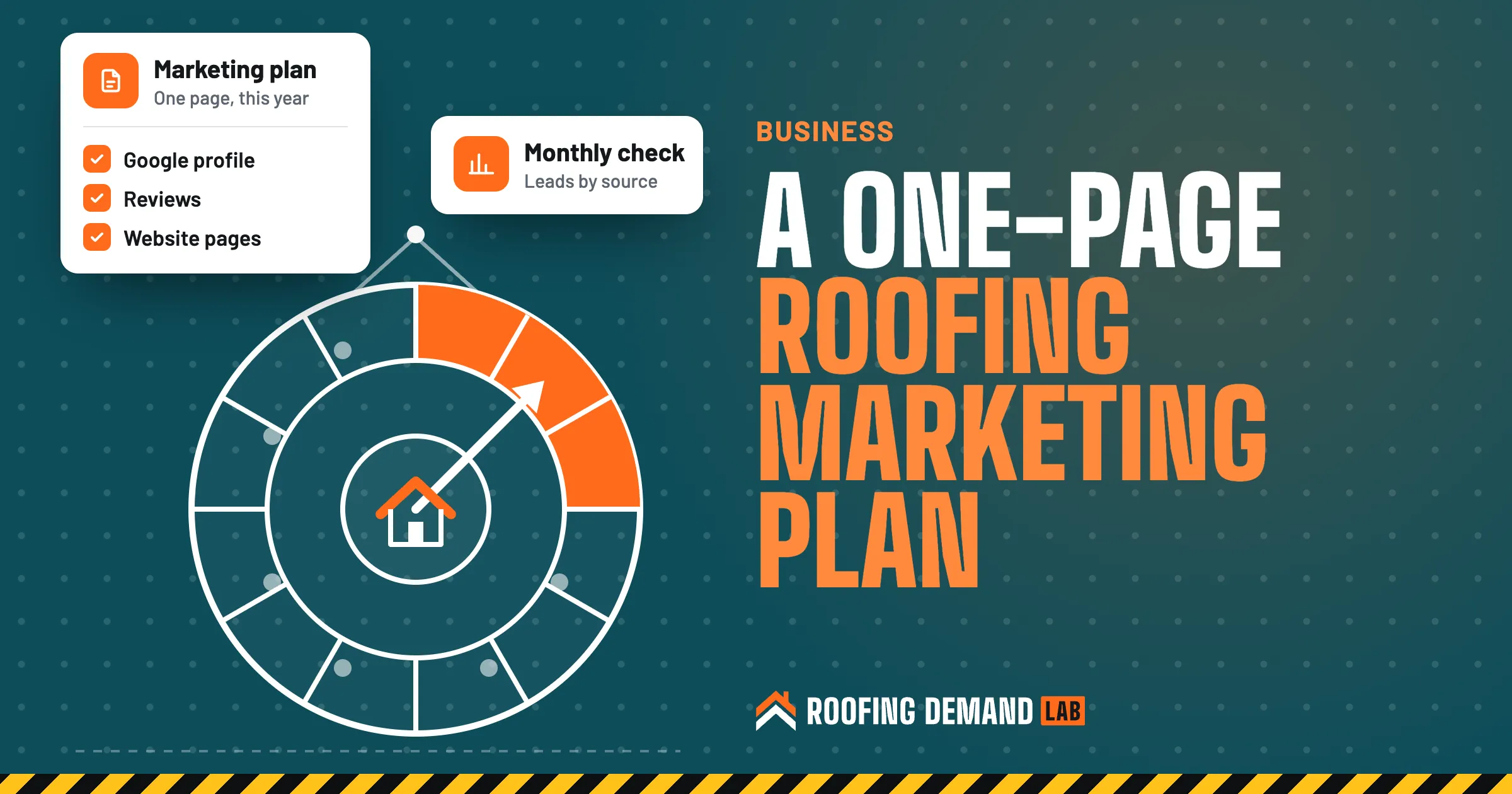
A roofing marketing plan is a single page that says who you want to hear from, how they’ll find you, what you’ll spend on each channel, and how you’ll know it’s working. That’s it. Most owners don’t need a binder. They need something they can tape inside the office door and check once a month without groaning.
The trouble is that most roofing marketing happens by reaction. A storm rolls through, so you boost a Facebook post. A rep pitches you a lead package, so you buy it. A slow month hits, so you print flyers. Each one might be fine on its own, but nobody can tell you afterward which one paid for itself. A plan fixes that by deciding ahead of time, and by writing down how you’ll measure each piece.
The short answer
Put six things on one page: the customers and towns you want, why they should pick you over the roofer down the road, a few goals you can count, the channels you’ll use, a budget for each channel, and how you’ll track where every lead came from. Then review it monthly and rewrite it at least once a year. The SBA recommends maintaining a marketing plan annually at a minimum.
Business plan vs. marketing plan
If you’ve already written a roofing business plan, you’ve done part of this. The SBA puts it simply: your business plan should hold the central pieces of your marketing strategy, and your marketing plan “turns your strategy into action” (SBA guide to marketing and sales (opens in a new tab)).
So the business plan says, “We’ll focus on residential reroofs in three suburbs.” The marketing plan says how: which listings, which pages, which ads, how much each costs, and who’s in charge of each one. It’s the working document. The business plan can sit in a drawer for a year. The marketing plan shouldn’t.
What goes on the page
The SBA lists the sections most marketing plans cover: target market, competitive advantage, sales plan, marketing and sales goals, a marketing action plan, and a budget, plus a habit of measuring and updating (SBA guide to marketing and sales (opens in a new tab)). Here’s how each one looks for a roofing company. Keep every section to a few lines. If a section runs long, you’re writing a business plan again.
1. The customers and towns you want
Write down the work you want more of and where you want it. “Anyone with a roof” isn’t a target. “Asphalt reroofs and repairs for homeowners in these five towns, plus small commercial flat roofs within 30 minutes of the shop” is.
Be just as clear about what you don’t want. If you hate chasing tiny repair calls an hour away, say so. Every channel below gets aimed at this line, and a vague target means ads and pages that pull in calls you’ll end up turning down.
2. Why they should pick you
The SBA calls this your competitive advantage: a better product, a better price, or a better customer experience. For roofers it’s usually something concrete. Maybe you do your own installs instead of subbing them out, or you hold a manufacturer certification, or you send photos of every stage of the job. Pick one or two honest reasons and use the same words on your website, your Google profile, and your ads. If you can’t name a reason, that’s worth knowing before you spend a dollar on ads.
3. A few goals you can count
The SBA suggests describing your marketing and sales goals for the next year. Keep the goals to things you control and can actually count each month:
- Ask every customer for a review when the job wraps up.
- Publish a page for every service and every town on your target list.
- Post on your Google Business Profile every week.
- Log the source of every inspection request.
Results like calls and signed jobs matter, but you can’t order them up. Track them, and set goals on the work that tends to produce them.
4. The channels you’ll use
This is the SBA’s “marketing action plan”: the channels you’ll use to hit those goals. Most roofers do better with four channels run well than ten run halfway. A sensible core for a local roofer looks like this:
- Google Business Profile. Google says local results are based mainly on relevance, distance, and popularity, and that there’s no way to request or pay for a better local ranking (Google’s local ranking tips (opens in a new tab)). A complete, active profile is the part you control.
- Reviews. They help homeowners decide, and they feed the profile.
- Your website. A page for each service and town, easy to use on a phone. Our roofing website design page covers what those pages need.
- One paid channel, if the budget allows, such as Google’s Local Services Ads or Search ads. Paid ads start faster than SEO and stop when the budget does.
Past-customer email, referrals, and job-site signs are cheap extras worth adding once the core is running. Our guide on how to get roofing leads walks through 10 channels if you want the full menu.
5. A budget for each channel
The SBA’s advice here is plain: include a complete breakdown of the costs and keep tracking them once the plan is running. For roofers, that means writing a number next to every channel, including the ones that “only” cost time. A Google profile is free, but somebody spends hours on photos and posts every month, and that hour has a price.
Don’t copy a percentage from someone else’s company. Work backward from your own numbers: what a typical job earns you after materials and labor, and what you can afford to spend to sign one. Our article on roofing business profit margin shows how to find those figures.
| Channel | Monthly cost | Who runs it | How you’ll track it |
|---|---|---|---|
| Google Business Profile | Time only | Office manager | Profile performance report |
| Website pages | Build fee or monthly plan | Agency or you | Form fills and tracked calls |
| Paid ads | Ad spend plus management | Agency or you | The ad account and call tracking |
| Past-customer email | Email tool | Office manager | Replies and booked inspections |
Fill in your own amounts. Leave room for a storm-season bump if your area gets one.
6. A calendar by season
Roofing is seasonal almost everywhere, but the seasons differ by region. Mark your own busy months, slow months, and storm months on a simple 12-month row. Then decide what each stretch is for. Slow months are a good time to build website pages, clean up your Google profile, and email past customers, since those take time to pay off. Busy months are for keeping review requests going and making sure nobody lets a call go to voicemail.
7. How you’ll track every lead
This is the part most plans skip, and it’s the part that makes next year’s plan better. Three habits cover most of it:
- Ask and log Every new caller gets asked how they found you, and the answer goes into your CRM or spreadsheet. (If you’re shopping for a system, see our roofing CRM guide.)
- Check the Google profile numbers Google’s performance report shows calls from the call button, website clicks, and direction requests from your Business Profile (Google’s Business Profile performance help (opens in a new tab)).
- Tag your links Add UTM tags (source, medium, and campaign) to the links in your emails, social posts, and ads, and Google Analytics will show which ones sent traffic in its traffic acquisition report (Google Analytics URL builder help (opens in a new tab)).
Rules that come with the channels
Your plan is also a good place to note the rules each channel brings. Google’s Maps content policy bars offering incentives for reviews and selectively asking only happy customers for them (Google’s prohibited and restricted content policy (opens in a new tab)). Marketing email falls under the CAN-SPAM Act, which requires a working opt-out, honoring opt-outs within 10 business days, and a valid physical postal address in every message (FTC CAN-SPAM compliance guide (opens in a new tab)). If you plan to text or call prospects, check the consent rules with an attorney first. This is general information, not legal advice.
The 30-minute monthly check
A plan only works if you look at it. Block 30 minutes on the first Monday of each month and answer the same questions:
- How many inspection requests came in, and from which source?
- What did each channel cost last month, including time?
- Did we hit the counted goals (review asks, pages, posts)?
- Which channel looks weakest, and do we fix it or cut it?
The SBA frames this as comparing your marketing and sales costs to the revenue they bring in, so you can see which part of the plan is working and which part needs to change (SBA guide to marketing and sales (opens in a new tab)). One slow month doesn’t mean a channel failed. Three in a row with no inspection requests usually means something needs to change.
Once a year, rewrite the page. Swap in next year’s towns, goals, and budget, and drop whatever didn’t earn its keep.
Mistakes that sink a marketing plan
- Too many channels at once. Each one needs setup and attention. Spreading thin usually means none of them gets done well.
- No owner for each line. “We’ll post on Google” without a name next to it means nobody posts.
- Judging SEO by the first month. Pages and profile work build over months, while ads can show activity in days. Give each one a fair window before you judge it.
- Not tracking the source. Without it, next year’s plan is another guess.
- Copying another company’s plan. Their towns, prices, and crew size aren’t yours.
If you’d rather hand the website, SEO, and Google profile work to someone else, those are bundled into our monthly plans, and our roofing digital marketing page lays out every service side by side.
Questions roofers ask about marketing plans
What should a roofing marketing plan include?
The SBA’s list works well for roofers: your target market, your competitive advantage, a sales plan, goals for the year, the marketing channels you’ll use, and a budget, plus a way to measure and update it. For a roofing company, add a seasonal calendar and a way to log the source of every lead. All of it can fit on one page.
How often should you update a marketing plan?
The SBA says marketing plans should be maintained on an annual basis at a minimum. In practice, review the numbers monthly and rewrite the plan once a year, or sooner if you add a service, move into new towns, or change your budget.
How much should a roofing company spend on marketing?
There’s no official figure, and a percentage borrowed from another company may not fit yours. Start with what a typical job earns you after materials and labor and what you can afford to spend to sign one, then set a budget per channel and adjust it as your tracking shows what’s working.
What’s the difference between a marketing plan and a business plan?
A business plan covers the whole company: services, market, management, pricing, and financials. The marketing plan zooms in on how you’ll reach customers, and the SBA describes it as the document that turns your marketing strategy into action. A practical rhythm is to write the business plan once and work from the marketing plan every month.