Business9 min read
Roofing Safety: What to Write Down Before a Crew Goes Up
Roofing safety starts on paper: the fall protection choice for each roof, ladder rules, a rescue plan, heat steps, and the training records owners should keep.

In this article
Roofing safety is mostly decided before anyone climbs a ladder. By the time a crew pulls up to a house, the big questions should already have answers: how each edge will be protected, who’s watching the job, how someone gets down if they’re hanging in a harness, and what happens when it’s 98 degrees by noon. If those answers only live in a foreman’s head, they change from job to job. Written down, they become the way your company works.
The short answer
A roofing safety plan is a short written document that says how every roof will be protected from falls, who the competent person is on each job, how ladders get set, how a fallen worker gets rescued, how the crew handles heat, and who has been trained. OSHA requires fall protection at 6 feet on roofs, a fall protection training program with a written certification record, and a safety program for construction employers. Write it once, keep a one-page version for each job, and update it when your crews, equipment, or roofs change.
This is general information, not legal advice or a compliance guarantee. Federal OSHA rules are the floor, and your state may run its own plan with its own rules.
What a roofing safety plan is (and what it isn’t)
Two different things get called a “plan,” and mixing them up causes trouble.
The first is your company safety plan. OSHA’s guide Protecting Roofing Workers (opens in a new tab) says all employers in the construction industry must have a safety program, including frequent and regular inspections of job sites, materials, and equipment, and training so workers can recognize and avoid unsafe conditions. That’s what most of this article is about.
The second is a written fall protection plan under OSHA’s rule at 29 CFR 1926.502(k) (opens in a new tab). That’s something much narrower.
Know which plan you mean
OSHA’s written fall protection plan is an alternative to guardrails, nets, and personal fall arrest systems, and it’s only available for leading edge work, precast concrete, or residential construction when the employer can show conventional protection is infeasible or creates a greater hazard (29 CFR 1926.501(b)(13) (opens in a new tab)). The same rule says there’s a presumption that at least one conventional system is feasible, and the employer carries the burden of showing otherwise. If you do use one, 1926.502(k) (opens in a new tab) requires it to be prepared by a qualified person, written for that specific site, kept at the job site, and supervised by a competent person. It is not a way to skip harnesses. Talk to a safety professional before you rely on one.
What to write down before a crew goes up
OSHA’s fall prevention campaign boils it down to three words: Plan. Provide. Train. (opens in a new tab) Your written plan covers all three. Here’s what belongs in it.
1. How each type of roof will be protected from falls
Start with the rule every roofer knows. Under 29 CFR 1926.501 (opens in a new tab), workers on a steep roof with unprotected sides and edges 6 feet or more above a lower level must be protected by guardrail systems with toeboards, safety net systems, or personal fall arrest systems.
Low-slope roofs get more options. The same section allows guardrails, safety nets, personal fall arrest, or a warning line combined with one of those or with a safety monitoring system. On low-slope roofs 50 feet or less in width, a safety monitoring system alone is allowed.
Write down which method your crews use on each roof type you work on, and what gear goes on the truck for it. Add holes and skylights too: OSHA requires protection from falling through holes, including skylights, more than 6 feet above lower levels, using personal fall arrest systems, covers, or guardrails.
2. Who the competent person is on each job
A lot of OSHA’s fall rules lean on a “competent person.” Your plan should name who that is for each crew, so it’s never a guess on the day. If you use a safety monitor on a low-slope job, 1926.502(h) (opens in a new tab) says the monitor has to be a competent person who can recognize fall hazards, stays on the same surface within sight of the workers, is close enough to talk to them, and has no other duties that pull their attention away.
That last part matters. A foreman who’s also measuring, loading, and taking phone calls isn’t a safety monitor.
3. How ladders get set
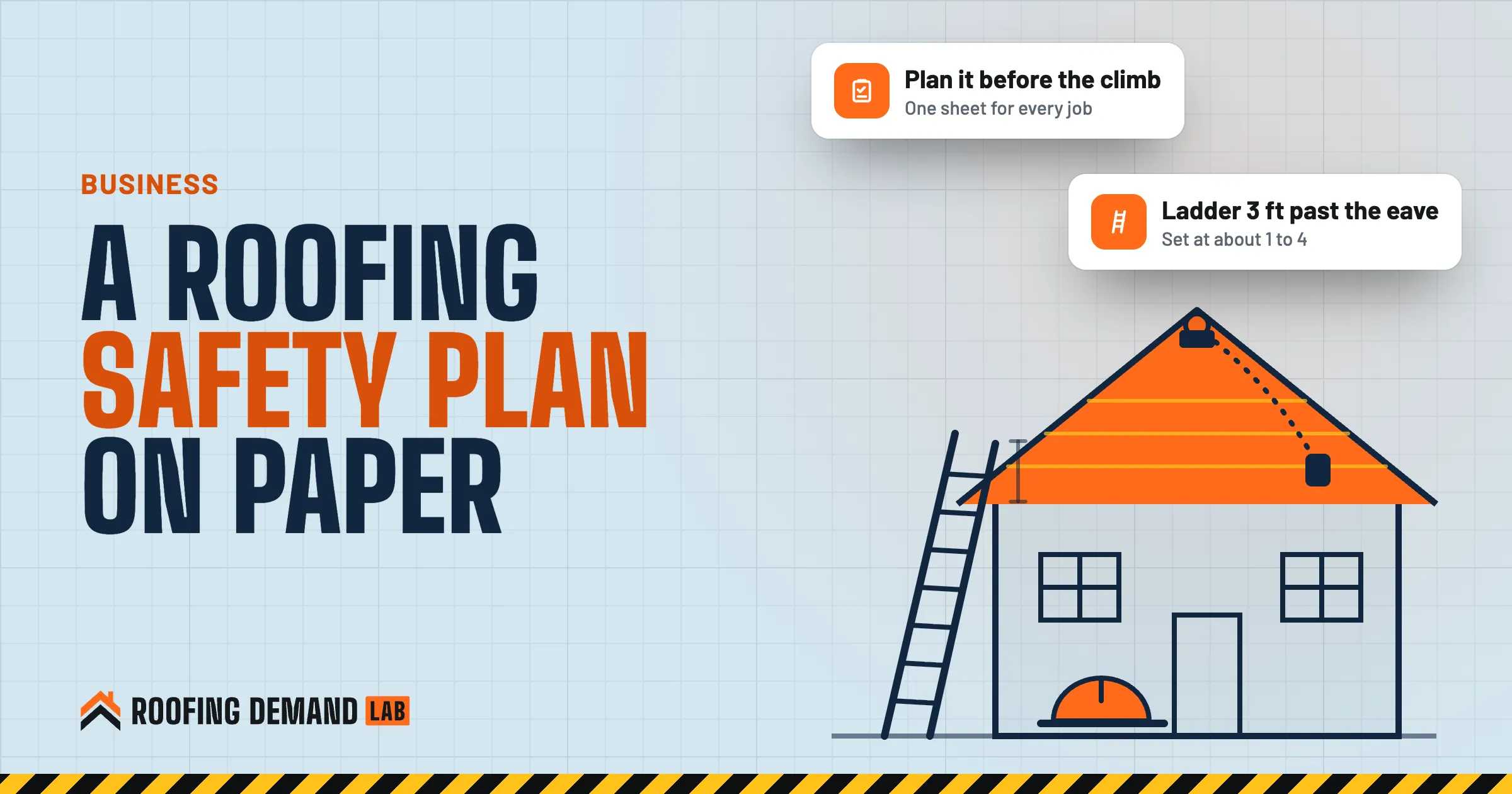
Ladders are where many roof jobs start, so put the setup rules in writing. OSHA’s ladder rule, 29 CFR 1926.1053 (opens in a new tab), says a portable ladder used to reach an upper landing must extend at least 3 feet above that landing, or be secured at the top with a grab rail when it can’t. A non-self-supporting ladder should sit at an angle where the distance from the wall to the foot is about one quarter of the working length.
A simple checklist on the truck helps: right ladder for the height, 3 feet above the eave, set at about 1 to 4, tied off, footing checked.
4. How a fallen worker gets rescued
A harness stops a fall. It doesn’t bring someone down. OSHA’s roofing guide says employers need a plan for rescuing workers whenever personal fall arrest systems are used, that a medical emergency called suspension trauma can develop if a fallen worker isn’t rescued quickly, and that rescue equipment should be evaluated before the job starts (Protecting Roofing Workers (opens in a new tab)).
Your plan should say who performs a rescue, with what equipment, and where it’s kept on the truck. Then practice it.
5. What the crew does in the heat
Heat is a roofing hazard in a lot of the country for months at a time. OSHA’s Water. Rest. Shade. (opens in a new tab) guidance says employers should provide cool water, provide electrolyte drinks for jobs that last more than two hours, and require breaks when heat stress is high, with breaks getting longer and more frequent as heat stress rises.
New hires need extra attention. OSHA’s page on protecting new workers (opens in a new tab) says almost half of heat-related deaths occur on a worker’s first day on the job or first day back after an extended absence, and over 70 percent happen during the first week. Write down how you ease new and returning workers into hot days.
6. Who has been trained, and when
This is the part owners most often skip, and it’s the part OSHA asks you to prove. Under 29 CFR 1926.503 (opens in a new tab), you must provide a fall protection training program for each employee who might be exposed to fall hazards, taught by a competent person.
Keep the training record
The same rule says the employer verifies training with a written certification record showing the employee’s name, the date of the training, and the signature of the trainer or the employer. Retraining is required when changes in the workplace or in the fall protection equipment make earlier training obsolete, or when a worker’s knowledge or use of fall protection shows they don’t understand it. OSHA’s roofing guide adds that training must be given in a language and manner workers can understand.
A shared folder or your CRM or job app can hold these records, as long as you can pull them up fast.
7. Safety gear in every estimate
Safety you didn’t price in tends to get skipped when the schedule is tight. OSHA’s fall prevention campaign (opens in a new tab) says that when estimating the cost of a job, employers should include safety equipment and plan to have it at the site, and it uses a roofing job as the example: think through holes, skylights, and leading edges, then pick the right protection.
Add a line for fall protection setup in your estimate template so it’s never the first thing cut.
Turn the plan into one page per job
A 30-page safety manual in the office doesn’t help a crew on a roof. Keep the company plan as the master copy, then fill out a short job sheet for each roof:
- Roof type, pitch, and height at the eaves
- The fall protection method and anchor locations
- Holes, skylights, and edges to cover or mark
- The competent person on site
- Rescue plan and where the gear is
- Heat plan for the day, if it applies
- Nearest hospital or urgent care address
The crew lead signs it before work starts. That gives you a record that the plan was followed, and it gives the crew one clear page instead of a binder.
This isn’t paperwork for its own sake. OSHA’s fall prevention campaign (opens in a new tab) calls falls the leading cause of death in construction and, citing BLS data, counts 389 fatal falls to a lower level out of 1,034 construction fatalities in 2024.
Get a second set of eyes on it
You don’t have to write this alone. OSHA’s On-Site Consultation Program (opens in a new tab) offers small and medium-sized businesses visits at no cost, kept confidential and separate from OSHA or State Plan enforcement, in all 50 states.
Also check whether your state runs its own program. OSHA says there are currently 22 State Plans (opens in a new tab) covering private sector workers, and they must be at least as effective as federal OSHA, so some rules may be stricter where you work. Your insurance agent may also have safety resources; our guide to roofing insurance covers what to ask about.
Let customers see it
Homeowners and property managers can’t see your safety plan, but they can see your photos. If the job pictures on your website and Google Business Profile show crews tied off with guardrails up, they back up everything you say about doing the job right. Photos that show the opposite say something too.
A few easy wins:
- Post job photos that show your fall protection in use, not shortcuts.
- Add a short safety section to your About page: training, equipment, and who to call with a concern.
- Mention safety training on your careers page. Good roofers look for companies that take it seriously.
If your site doesn’t have room for any of that, our roofing website design is included in every monthly plan. For the weekly routine that keeps a company like this running, see how to run a roofing business.
Questions roofers ask about roofing safety
When should a safety monitor be used for roofing?
OSHA allows a safety monitoring system on low-slope roofs, together with a warning line, and alone on low-slope roofs 50 feet or less in width (29 CFR 1926.501 (opens in a new tab)). It isn’t one of the listed options for steep roofs. The monitor must be a competent person on the same roof, within sight and talking distance, with no other duties (1926.502(h) (opens in a new tab)).
What are the OSHA requirements for safety on a roof?
The core one is fall protection at 6 feet: guardrails with toeboards, safety nets, or personal fall arrest on steep roofs, with more options on low-slope roofs (29 CFR 1926.501 (opens in a new tab)). Add ladder rules, protection at holes and skylights, a fall protection training program with a written certification record, and a company safety program. Check whether your state has its own OSHA plan too.
What are the biggest safety risks for roofers?
Falls come first. OSHA’s roofing guide says falls are the leading cause of work-related injuries and deaths among roofers (Protecting Roofing Workers (opens in a new tab)). Heat is a big one for crews working in summer, especially in a worker’s first days on the job (OSHA heat guidance (opens in a new tab)).
Do I need a written fall protection plan?
Usually not, because most roofs can be protected with guardrails, nets, or personal fall arrest, and OSHA presumes that’s feasible. A written fall protection plan under 1926.502(k) (opens in a new tab) is only an option for certain work, like residential construction, when you can show conventional protection is infeasible or more dangerous. You still need a company safety program and training records either way.