Business8 min read
Roofing License: How Licensing Works State by State for Owners
How a roofing license works for owners: state vs. local rules, the qualifier, bonds, and where your license number has to appear in ads, bids, and trucks.

In this article
There’s no national roofing license. Each state decides whether to license roofers, and the answers run from a full state license with an exam and a bond to no state license at all, with cities filling the gap. For an owner, the license also does more than keep you legal. In several states the number has to show up on your ads, your bids, and even your trucks, and Google can ask for it before your Local Services Ads run.
This guide walks through how roofing licensing is usually set up, using four states that handle it four different ways, and then covers the part most licensing guides skip: what the license means for your marketing.
The short answer
Roofing licenses are set by each state, and some states leave most of it to cities and counties. Where a state license exists, it usually hangs on one qualified person (the qualifier), and often needs an exam, insurance, and a bond. Several states also require your license number on every ad, contract, and bid. Check your state’s contractor licensing board and each town’s building department before you take work there.
General information only
Licensing laws differ by state, county, and city, and they change. This article is general information, not legal advice. Confirm the rules with your state licensing board, your local building departments, and an attorney before you rely on them.
How roofing licensing is set up
Most roofing licensing falls into one of three setups. Some states license roofing contractors directly. Some fold roofing into a broader contractor license. And some have no state license for roofers, which leaves registration and permits to local governments.
The SBA puts the local side plainly: “Local governments determine registration, licensing, and permitting requirements” (SBA on licenses and permits (opens in a new tab)). So even in a state with a roofing license, the town you’re working in may still want a registration and a permit.
Here’s how four big roofing states compare, based on each state’s own board or statute:
| State | Who licenses roofers | What stands out |
|---|---|---|
| Florida | Construction Industry Licensing Board | Certified (statewide) or registered (local) license |
| California | Contractors State License Board | C-39 Roofing class, license needed at $1,000 and up |
| Illinois | Dept. of Financial and Professional Regulation | Limited (residential) or unlimited license |
| Texas | No state roofing license | Cities and counties set their own rules |
Four states, four setups
Florida: certified or registered
Florida’s Construction Industry Licensing Board licenses roofing contractors, and there are two kinds. A certified contractor “shall be allowed to contract in any jurisdiction in the state,” while a registered contractor qualifies through a local jurisdiction and “may contract only in such jurisdictions” (Fla. Stat. 489.105 (opens in a new tab)). If you plan to work in more than one county, that difference matters before you apply. The board’s application forms, including the exam application, are on the Florida DBPR construction licensing page (opens in a new tab).
California: the C-39 and the $1,000 line
California’s Contractors State License Board has a roofing classification, the C-39. The board describes a roofing contractor as one who “installs products and repairs surfaces that seal, waterproof and weatherproof structures” (CSLB C-39 Roofing (opens in a new tab)).
The CSLB’s licensing guide says any project “valued at $1,000 or more in labor and materials combined” needs a licensed contractor, and if the work needs a permit or workers, a license is required no matter the cost. The license’s qualifier needs four years of at least journey-level experience in the last 10 years in that trade, and has to pass the required exams (CSLB: Get Licensed to Build (opens in a new tab)). The board also requires a $25,000 contractor’s bond on file (CSLB guides and publications (opens in a new tab)).
Illinois: limited or unlimited
Illinois licenses roofing contractors through the Department of Financial and Professional Regulation (IDFPR roofing contractor page (opens in a new tab)). Under the Roofing Industry Licensing Act, you apply for either a limited or an unlimited license. The limited license’s exam covers residential roofing, and the unlimited exam covers residential, commercial, and industrial work (225 ILCS 335/3.5 (opens in a new tab)). Holders of a limited license can only pull permits for residential properties of 8 units or less (225 ILCS 335/5 (opens in a new tab)).
The application also asks for liability insurance, workers’ comp, and a continuous bond “in the amount of $10,000 for a limited license and in the amount of $25,000 for an unlimited license” (225 ILCS 335/3 (opens in a new tab)).
Texas: no state license, local rules
Texas is the big example of a state without a roofing license. A 2025 House committee analysis of a bill to create one stated that “Texas does not currently require a state-issued license for reroofing contractors” (Texas House bill analysis, HB 3344 (opens in a new tab)). The bill’s last recorded action was a committee report in May 2025 (HB 3344 history (opens in a new tab)). That doesn’t mean anything goes. Local governments can still set their own registration and permit rules, so check with the building department in every city you work in.
The qualifier: the person the license hangs on
In most licensing states, the license runs through one qualified person. Florida calls this person the qualifying agent and says a business “may not engage in contracting until a qualifying agent is employed” (Fla. Stat. 489.119 (opens in a new tab)). Illinois calls it the qualifying party, the person who takes the exam and must “actively participate in the day-to-day operations” of the company. Illinois also says the qualifying party has to be a payroll employee and “shall not receive a Form 1099” from the business (225 ILCS 335/3 (opens in a new tab)).
That’s fine when the qualifier is you. It gets risky when it’s a partner or a long-time foreman, because if they leave, the company’s ability to contract can go with them.
Plan for your qualifier leaving
Find out now what your state requires when a qualifier leaves, how long you have to replace them, and whether you can keep working in the meantime. Ask your licensing board, and put the answer in writing for whoever runs the office.
Where your license number has to show up
Here’s where licensing turns into a marketing job. Several states require the license number in places owners don’t always think about.
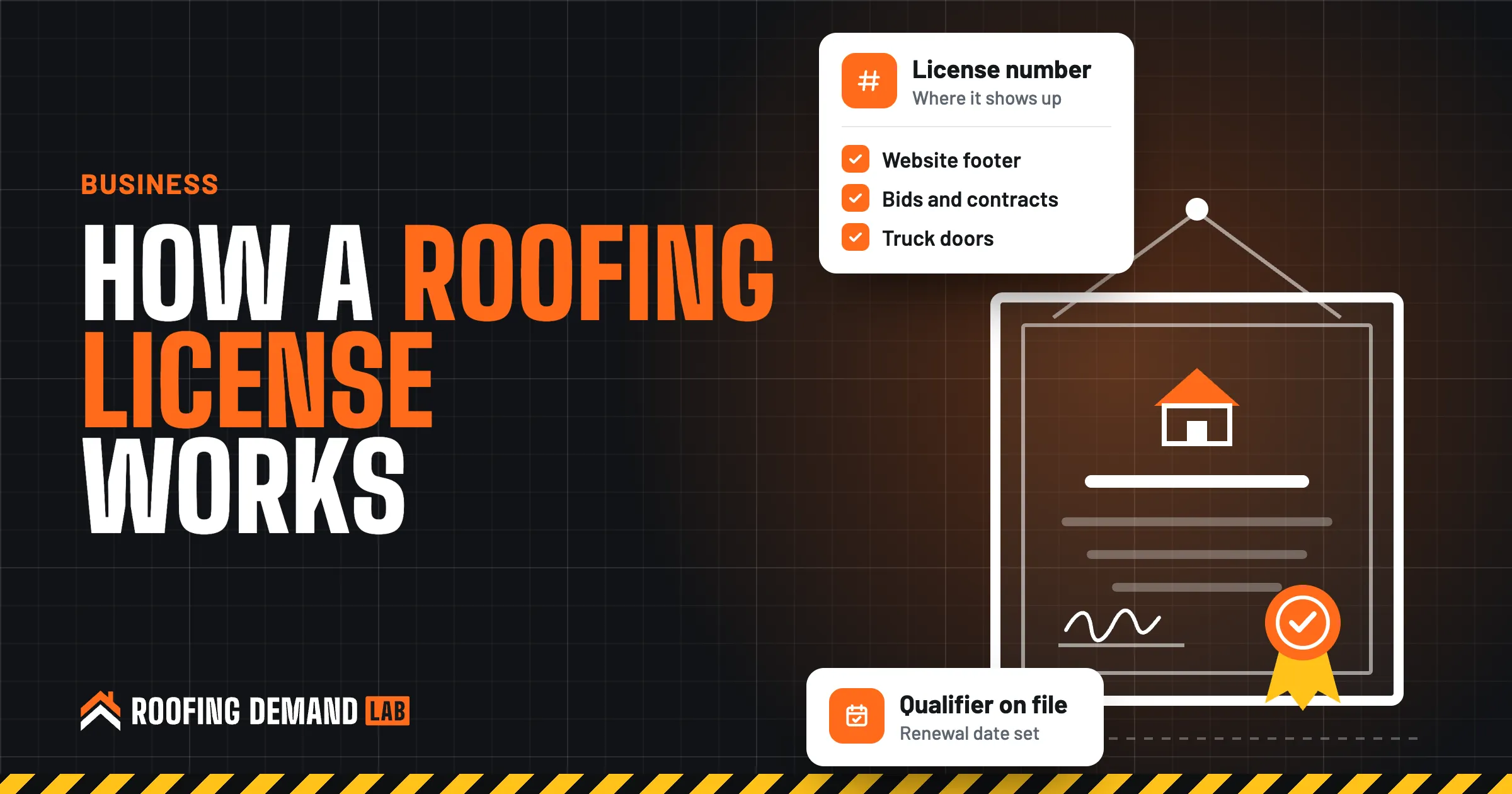
1. In your ads, including your website
Florida requires the license number “in each offer of services, business proposal, bid, contract, or advertisement, regardless of medium” (Fla. Stat. 489.119 (opens in a new tab)). California’s board says licensed contractors must include it in “all forms of advertising,” with a civil penalty of $100 to $1,000 for a first offense (CSLB advertising guidelines (opens in a new tab)). Illinois says no licensee may advertise unless the ad includes the license number and the name as it appears on the license (225 ILCS 335/5 (opens in a new tab)).
The easy fix: put the number in your website footer so it’s on every page, and add it to your ad templates, social profiles, flyers, and yard signs. If you’re having a roofing website built, ask for the number in the footer from day one, so nobody has to remember to add it later.
2. On every contract and bid
Florida and Illinois both require the number on contracts and bids, and Illinois adds the licensee’s name exactly as it appears on the license. The FTC also tells homeowners to look for “the contractor’s name, address, phone number, and license number” before they sign (FTC: how to avoid a home improvement scam (opens in a new tab)). Our roofing contract guide covers what else belongs in the document.
3. On your trucks
California requires contractors to show their business name and license number on each commercially registered vehicle, in letters at least three quarters of an inch high and wide (CSLB advertising guidelines (opens in a new tab)). If you’re designing a wrap, build the number into it. See our guide to roofing truck wraps for the rest of the layout.
4. In your Google ads and profile
If you run Google Local Services Ads, Google says its screening “may include verification of licenses or insurance,” depending on the business category and country (Google Local Services verification (opens in a new tab)). Have a current license and insurance certificate ready before you sign up, and make sure the business name on them matches what you’ll enter. Our roofing PPC page covers how we set those campaigns up.
Your Google Business Profile has no license field, but the name rules still connect. Google says your name “should reflect your business’s real-world name” as used on your storefront, website, and stationery (Google Business Profile guidelines (opens in a new tab)). Keep the name on your license, profile, website, and contracts the same, and a homeowner who looks up your license is less likely to wonder whether they found the right company. Our Google Business Profile guide walks through the rest of the setup.
When you grow, sell, or change your company
A license often belongs to a specific person or entity, not the brand. California’s board says “a new license is required whenever the business entity changes,” and that licenses “are not transferable from one business to another, even if the qualifying individual is the same for both” (CSLB on changes in business entity (opens in a new tab)). So turning a sole proprietorship into an LLC can mean a new license, and so can selling. Our guide to selling a roofing business covers the license question from the buyer’s side.
The same goes for expanding into a new state or county. Each one is its own licensing question, so start before you print the yard signs. If you’re just getting going, our guide on how to start a roofing company covers registration, insurance, and the rest of the setup.
A quick license checklist for owners
- Know your setup State license, local registration, or both, for every place you work.
- Protect the qualifier Know who it is, what happens if they leave, and when the license renews.
- Keep the paperwork current Insurance, workers’ comp, and any bond your state requires.
- Put the number everywhere Website footer, ads, social profiles, contracts, bids, and trucks where required.
- Match the names The same business name on your license, Google profile, website, and contracts.
Questions roofers ask about roofing licenses
Do roofers need a license in Texas?
Texas doesn’t have a state license for roofers. A 2025 House committee analysis said the state “does not currently require a state-issued license for reroofing contractors.” Cities can still set their own registration and permit rules, so check with each city’s building department before you take work there.
What states do not require a roofing license?
There’s no single official list, and laws change, so the safest move is to check your own state’s contractor licensing board. Texas is one state with no state roofing license, but even there, cities can set their own registration and permit rules.
How long does it take to get a roofing license?
It depends on the state and on whether your qualifier already has the experience. California, for example, wants four years of journey-level experience in the last 10 years before the qualifier can apply, then exams and a bond. Ask your state board for current processing times before you plan a start date.
How do you get a roofing license in Florida?
Florida’s Construction Industry Licensing Board handles it. You choose between a certified license, which covers the whole state, and a registered license, which is limited to the local areas where you qualified. The application and exam forms are on the DBPR construction licensing page, and an attorney or the board can confirm which path fits your plans.