Lead generation9 min read
Roofing Commercials: What to Know Before You Buy TV or Radio Ads
Roofing commercials on TV, radio, streaming, or YouTube: what a 30-second spot needs, how to track it, and the ad rules to check before it airs.

In this article
A roofing commercial is a short ad for your company on TV, radio, a streaming service, or YouTube. It does a different job than a Google ad. A Google ad reaches someone searching for a roofer right now. A commercial reaches people who aren’t thinking about their roof at all, so that when a stain shows up on the ceiling, your name is the one they already know. That only pays off if the spot is built right, the ad rules are covered, and you can tell whether it did anything.
The short answer
A good roofing commercial says your company name early and more than once, sticks to one message, shows your own work, and ends with one easy way to reach you, usually a short web address. Before it airs, check your state’s license number rules, make sure you can back up every claim, and keep insurance claims out of it. Then give the spot its own tracked web address and ask every caller how they heard about you.
Looking for flat roofs and building owners instead? That’s our guide to commercial roofing leads.
What a roofing commercial can and can’t do
Most homeowners rarely shop for a roofer. When they do, plenty of them search Google, read reviews, and call whoever looks trustworthy. A commercial can’t skip that step. What it can do is make your name feel familiar by the time they search, so they pick you over a company they’ve never heard of.
That changes how you judge it. A commercial rarely makes the phone ring the minute it airs. It tends to show up later, as more people searching your company name and callers who say “I’ve seen you on TV.” Expect it to behave like a Google Ads campaign and you’ll probably cancel it too early.
It also means the spot sends people somewhere. If your reviews are thin or your website is hard to use on a phone, you’re paying to send people to a weak first impression.
A commercial makes people look you up. Make sure what they find is worth a call.
Where roofing commercials run
| Channel | How it’s usually bought | What to plan for | How to track it |
|---|---|---|---|
| Broadcast TV | A local station’s sales team | Producing the spot, plus the schedule of airings | A web address only this ad uses |
| Radio | A local station, often as a package | No pictures, so the name and web address have to be heard clearly | A web address only this ad uses, plus asking callers |
| Streaming TV | Streaming ad sellers, or a local station or cable sales team | What you can target varies by seller | Seller reports plus a dedicated web address |
| YouTube | Google Ads video campaigns | Some ads can be skipped after a few seconds | Google Ads reports plus your website analytics |
Rates change by market, season, and time slot, so get each proposal in writing. Ask what’s included: production, how many airings, which hours, and whether it also runs on the station’s app. Ask who owns the finished commercial, too, so you keep the footage if you switch stations.
What a 30-second roofing commercial needs
Thirty seconds goes fast. Here’s what earns a place in it.
1. Say your name early, then say it again
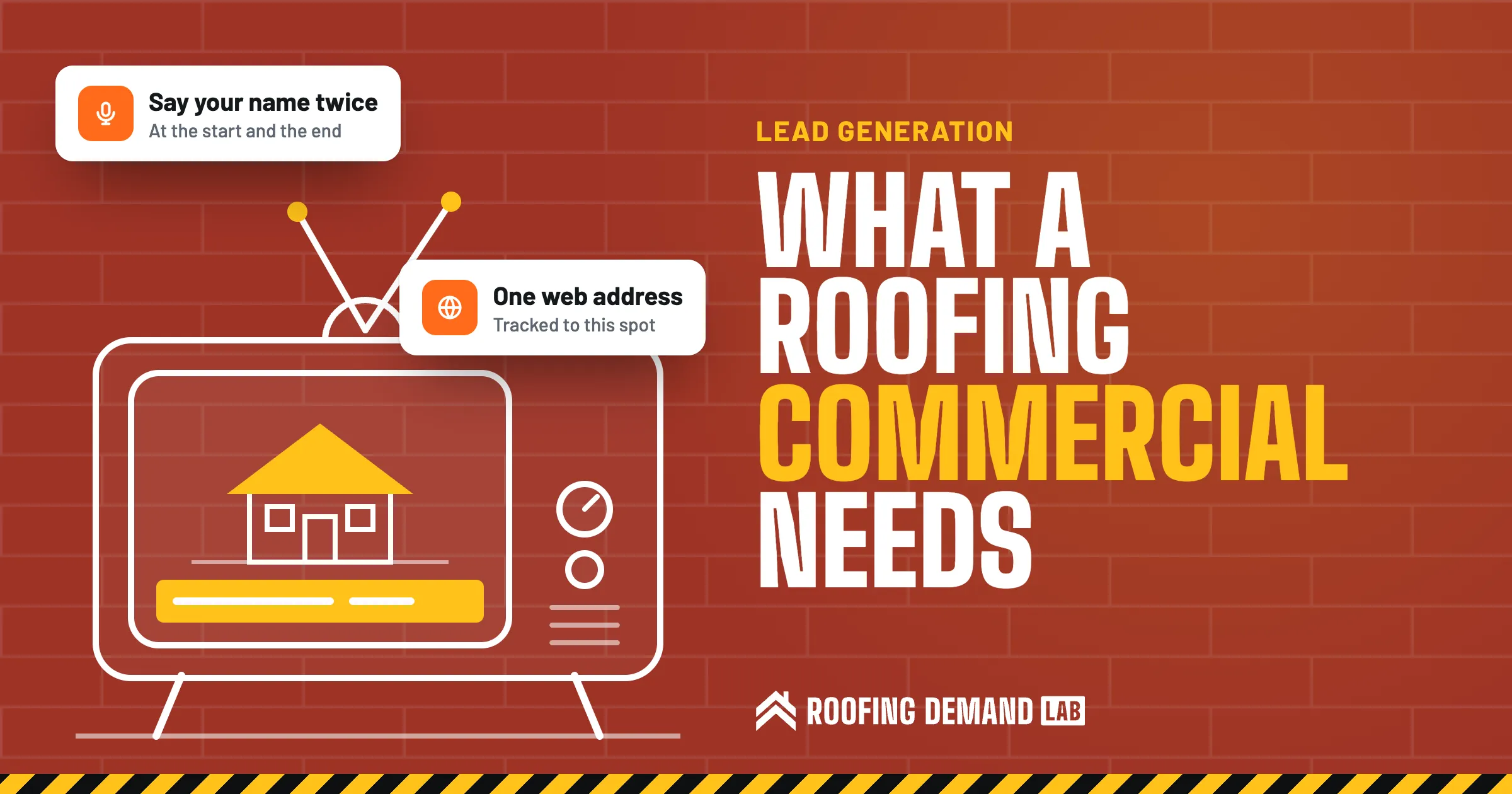
People half watch commercials while they cook, drive, or scroll. If your name only shows up in the last three seconds, a lot of them will miss it. Say it near the start, keep it on screen, and say it again at the end. On radio, say it at least twice, slowly.
2. Pick one message
A spot that rattles off replacements, repairs, gutters, siding, windows, and financing is hard to remember. Choose one thing you want people to know. “We fix roof leaks in Springfield, and we show you photos of the problem before we start” is one message. Save the full service list for your website.
3. Show your own roofs, trucks, and crews
Stock footage of a generic house looks like every other ad. Your own trucks, crews, and finished roofs on streets people recognize say “local company” without a word. If the owner is comfortable on camera, that often lands better than a hired announcer. Anything filmed on a roof should show the same fall protection you’d use on any job.
4. End with one way to reach you
Give people one thing to remember. A short web address is usually easier to hold onto than a phone number heard once on the radio. Point it at a landing page that repeats the spot’s message and makes booking an inspection easy. If you also show a number, leave it on screen long enough to read.
5. Put your license number where your state requires it
Check your state’s ad rules
Some states treat a commercial like any other ad. California’s Contractors State License Board lists radio alongside newspapers, vehicle lettering, and websites as ways contractors advertise, says licensed contractors must include their license number in all forms of advertising, and puts the civil penalty for a first offense between $100 and $1,000 (CSLB advertising guidelines (opens in a new tab)). The same guide says the law prevents you from noting in your advertising that you are bonded. Florida requires a contractor’s registration or certification number in each advertisement, “regardless of medium” (Florida Statutes 489.119 (opens in a new tab)). Other states have their own rules. Ask your state licensing board how the number has to appear in a TV, radio, or online video ad before you produce one.
6. Cut a version for the skip button
On YouTube, the first few seconds carry most of the weight. Google says viewers can skip a skippable in-stream ad after 5 seconds, and that bumper ads are non-skippable video ads lasting between 5 and 6 seconds (Google Ads help on video ad formats (opens in a new tab)). Put your name and the problem you fix in the opening, and consider a six-second cut: name, one line, web address.
Rules to check before it airs
None of this is legal advice. It’s a list to raise with the station, your producer, and an attorney.
Back up every claim
Claims need proof first
The FTC says advertising must be truthful and non-deceptive, that advertisers must have evidence to back up their claims, and that the law requires advertisers to have proof before the ad runs (FTC advertising FAQs for small business (opens in a new tab)). “Best roofer in the county” or “lowest prices in town” are claims you’d have to support. Stick to what you can show: years in business, your license, the warranty you actually offer.
Use real customers honestly
Customers can work well on camera. The FTC’s endorsement guidance says an endorsement must reflect the honest opinion of the endorser, and that a connection between the endorser and the business, like an employee or a relative appearing in the ad, should be disclosed clearly and conspicuously (FTC endorsement guides FAQ (opens in a new tab)). Don’t script lines they wouldn’t say, and get written permission to use their name, face, or house.
Know how sponsor announcements work
When a broadcast station airs something it was paid for, FCC rules require the station to announce that it’s sponsored and who paid. For ads about commercial products or services, naming the company or the product is enough when it’s clear that the mention is the sponsorship identification (FCC sponsorship identification rules (opens in a new tab)). An ordinary commercial that clearly names your company is the simple case.
Paid mentions inside a show are different. If you pay a radio host to talk up your company, the FCC says the person paying and the person paid both have to disclose it ahead of time so the station can announce it. Ask the station how it handles sponsored segments first.
Keep insurance claims out of it
Storm and insurance wording
Florida’s law on prohibited advertisements covers any written or electronic communication by a contractor that encourages a consumer to contact a contractor about a roof damage insurance claim, and it requires specific disclosures, including that the consumer is responsible for paying any deductible (Florida Statutes 489.147 (opens in a new tab)). Other states may have their own rules. Keep claim language out of your commercials, and have an attorney review any storm-related spot before it runs. This is general information, not legal advice.
License the music
A song isn’t yours to use in an ad because you bought the album. The U.S. Copyright Office says the way to get permission to use somebody else’s work is to ask for it, contacting the copyright owner directly if you know who that is (Copyright Office FAQ (opens in a new tab)). Use music licensed for commercial use, or have a track made, and keep the paperwork.
How to tell if a roofing commercial is working
- Give it its own web address Use a short address only this commercial mentions, forwarded to your landing page with tracking tags. Google Analytics says you should always use utm_source, utm_medium, and utm_campaign when you add these parameters (Google Analytics help on custom URLs (opens in a new tab)). Something like
utm_source=tv&utm_medium=commercial&utm_campaign=spring-repairskeeps the spot separate in your reports. - Ask every caller how they heard about you Log the answer in your CRM, and keep TV and radio separate.
- Watch searches for your company name A commercial that’s doing its job often shows up as more people searching for you by name. Compare the weeks before a run with the weeks during and after it.
- Judge it by booked inspections Divide what the whole run cost by the inspections it booked, and compare that with your other channels.
Before you text or call back
Someone who contacts you after a commercial is reaching out on their own. Adding them to marketing texts or recorded calls is a different thing. The FCC says its rules require a caller to obtain oral or written consent before making an autodialed or prerecorded call or text to a wireless number (FCC guide to unwanted calls and texts (opens in a new tab)). Get consent before anyone goes on a list.
Get your online basics ready before you buy airtime
A commercial sends people to Google, so get these ready before the first spot runs:
- Your Google Business Profile is complete, with current hours, your service area, and real photos.
- You have recent reviews, because you ask every customer for one.
- Your website is fast on a phone and has a page that matches the commercial’s message. Our roofing website design is included in every monthly plan.
- Search ads catch the people who look you up after the spot. We run Google Ads for roofers as an add-on.
Questions roofers ask about roofing commercials
Can a local roofing company afford TV advertising?
It depends on your market, the station, and how often the spot runs, so get written rates from a few sellers. Ask for the smallest package and whether you can test streaming or online video first. Treat any buy as a test with an end date and a tracked web address.
How do I start TV advertising for my roofing company?
Get your website, reviews, and Google Business Profile in shape first, then decide on one message. Talk to local station sales teams and get written proposals that spell out production, airings, and who owns the footage. Set up a tracked web address before the first airing so you can measure it from day one.
How long should a roofing commercial be?
Stations sell set lengths, so ask what each one offers. On YouTube, Google says viewers can skip a skippable in-stream ad after 5 seconds (Google Ads help on video ad formats (opens in a new tab)), so a short cut that leads with your name is worth having. Whatever the length, stick to one message.
Do I need my license number in a radio or TV ad?
In some states, yes. California’s contractor board counts radio as advertising and requires the license number in all forms of it (CSLB advertising guidelines (opens in a new tab)), and Florida requires the number regardless of medium (Florida Statutes 489.119 (opens in a new tab)). Check your own state’s board first.