Lead generation9 min read
How to Get Commercial Roofing Leads: 8 Places to Find Work
How to get commercial roofing leads from property managers, general contractors, public bids, and maintenance plans, plus the paperwork buyers ask for first.

In this article
- How commercial roofing leads differ from residential
- Get your paperwork ready before you chase anyone
- 8 ways to get commercial roofing leads
- 1. Start with the small buildings near you
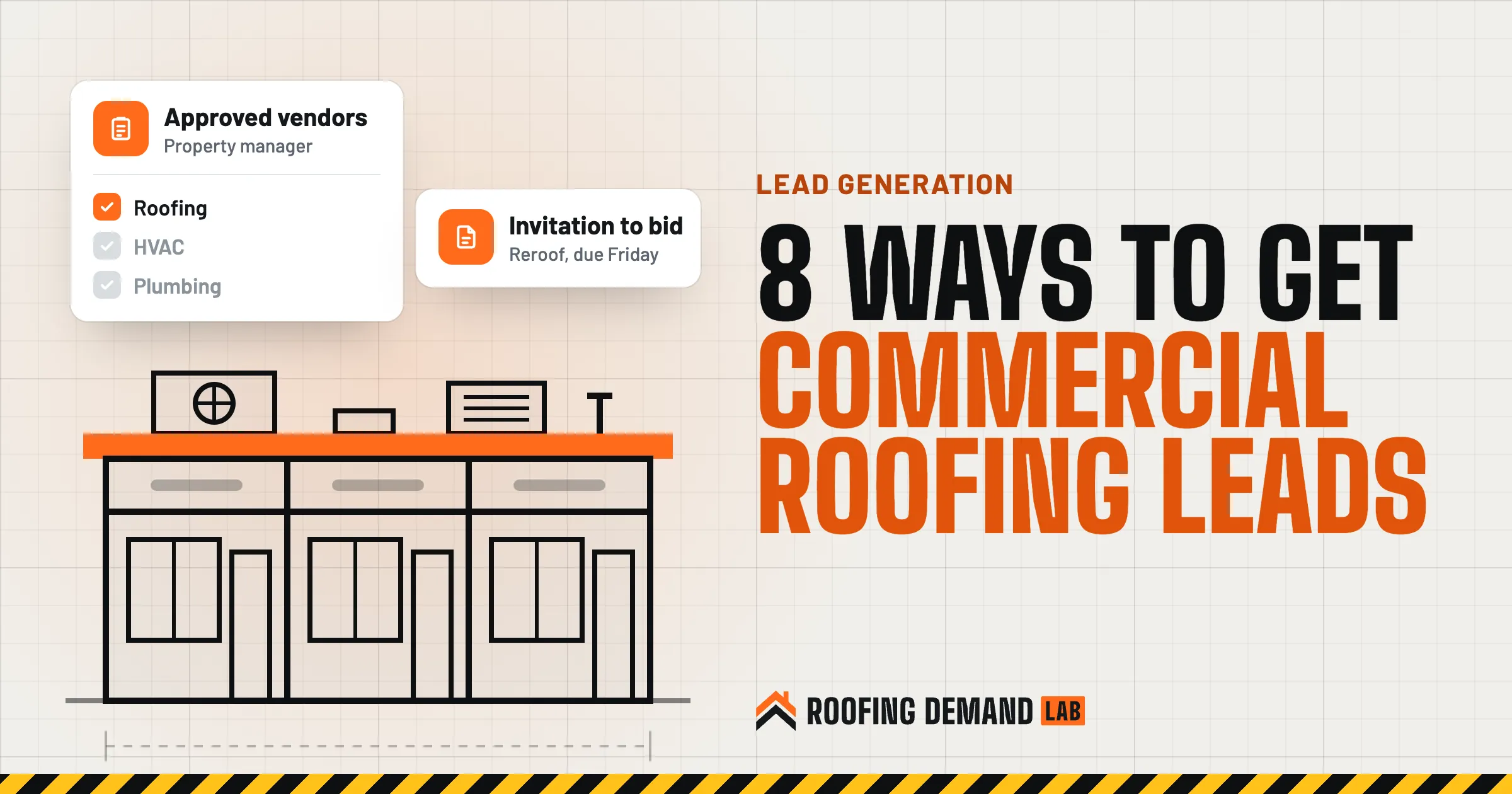
- 2. Get on property managers’ vendor lists
- 3. Sell maintenance agreements, not just roofs
- 4. Get on general contractors’ bid lists
- 5. Bid public work
- 6. Give commercial work its own pages on your website
- 7. Run search ads for commercial repair searches
- 8. Reach out directly, and follow the rules
- Should you buy commercial roofing leads?
- Where to start
- Questions roofers ask about commercial roofing leads
Commercial roofing leads don’t behave like residential ones. A homeowner with a leak calls three roofers and picks one by Friday. A property manager with a leak calls the roofer already on their vendor list. Months later, when that building needs a new roof, the job gets bid out to a short list of contractors who already did good work there. If you’re not on the list, you never hear about it.
So most of the work of getting commercial roofing leads happens before anyone needs a roof. Below are eight places those leads come from, plus what buyers ask for before they let you bid. (For homeowner work, see our guide on how to get roofing leads.)
The short answer
Commercial roofing leads mostly come from the people who run buildings: property managers, facility managers, general contractors, and public agencies. Have your insurance, safety, and bonding paperwork ready, get on vendor and bid lists, and offer maintenance agreements so you’re more likely to get the first call when a roof has a problem. Commercial pages on your site and targeted search ads can bring in repair calls that open doors.
How commercial roofing leads differ from residential
| Residential | Commercial | |
|---|---|---|
| Who decides | The homeowner | A property manager, facility manager, owner, board, or general contractor |
| How they find a roofer | Google, reviews, neighbors | Vendor lists, bid invitations, other managers |
| How the job is awarded | Inspection and estimate, often within days | Bids against a written scope, sometimes over months |
| What they check | Reviews, photos, price | Insurance certificates, safety program, references, sometimes bonding |
| What one good job leads to | A referral or two | A shot at the other buildings that manager runs |
That last row is the one to remember. Do one repair well for a property manager and you have a shot at the rest of their buildings. Do it badly and you’re off the list for all of them.
Get your paperwork ready before you chase anyone
Commercial buyers vet contractors before they invite bids. Have these ready to send the day someone asks:
- Certificates of insurance. Expect requests for general liability and workers’ comp certificates, often naming the manager’s company as an additional insured.
- License details for every state where you’ll work. Ask your state’s contractor licensing board whether your license covers commercial work and whether it limits job size.
- A written safety program. For roofing work on low-slope roofs with unprotected edges 6 feet or more above a lower level, OSHA requires fall protection such as guardrails, safety nets, personal fall arrest systems, or a warning line combined with another system (OSHA’s fall protection standard, 1926.501 (opens in a new tab)). Buyers want to see you have a plan for that.
- A project list with the building type, roof system, size, and a reference contact for each job (ask those clients first).
- Bonding capacity, if you plan to bid public work or larger private jobs. More on that below.
Insurance and licensing
This is general information. Coverage needs, license classes, and bond requirements vary by state and by contract, so check with your state licensing board and a licensed insurance or surety agent before you bid commercial work.
8 ways to get commercial roofing leads
1. Start with the small buildings near you
“Commercial” sounds like warehouses and big-box stores. Most commercial buildings aren’t. The U.S. Energy Information Administration estimated 5.9 million commercial buildings in its 2018 survey. Of those, 71% were 10,000 square feet or smaller, and the median was 5,400 square feet (EIA’s 2018 commercial buildings highlights (opens in a new tab)).
That’s strip centers, small offices, churches, restaurants, and auto shops. For a roofer moving into commercial work, they’re the natural first market: jobs a smaller crew can handle, and often an owner who answers the phone.
So make a list. Drive your service area and write down the commercial buildings with roofs you can work on. Your county’s property records may show who owns each one.
2. Get on property managers’ vendor lists
Property management companies and facility managers keep lists of approved contractors. When a tenant reports a leak, the manager calls someone on that list. Getting on it is about as close as commercial roofing comes to a steady lead source.
Call the management companies in your area, ask who handles vendor approval, and send your paperwork. Some will send a vendor packet or ask you to sign up with an outside service that tracks insurance certificates. Fill it out the same week.
Then answer fast. The first calls will probably be small: a clogged drain, flashing that blew loose. Treat them like auditions. Show up when you said you would, send photos of what you found and fixed, and invoice cleanly. Managers talk to each other.
3. Sell maintenance agreements, not just roofs
A maintenance agreement may be the best commercial lead source you can build yourself. You inspect the roof on a schedule (spring and fall is common), clear drains and debris, make small repairs, and send the owner a short report with photos after every visit.
You get paid work between big jobs, and the owner hears about problems from you first. When the roof does need replacing, you’ve documented its condition for years, which puts you in a strong spot to bid it.
Put the scope, the visit schedule, your leak response time, and the price in writing.
4. Get on general contractors’ bid lists
New construction and big renovations usually run through a general contractor, and the GC subcontracts the roof. GCs keep bidder lists by trade and send invitations to bid to the subs on them.
Call the estimators at the GCs in your area, ask how they add roofing subs, and send your paperwork and project list. When an invitation comes in, read the whole package and price what the drawings and specs ask for. Late or incomplete bids are an easy way to fall off a list.
You don’t have to bid everything. A quick “we’ll pass on this one” beats a rushed number you can’t stand behind.
5. Bid public work
Public agencies post their work openly, which makes them unusual among commercial buyers. Federal agencies are required to use SAM.gov to advertise all contracts over $25,000, and the details you enter when you register in SAM feed the database agencies search for small business contractors (SBA’s guide to winning contracts (opens in a new tab)). States, counties, cities, and school districts run their own bid systems, so check their procurement pages too.
You don’t need a prime contract to get started. Large businesses can post subcontracting opportunities on the SBA’s SubNet database, and small businesses can search them. The SBA also points small businesses to APEX Accelerators for help finding that work (SBA’s subcontracting guide (opens in a new tab)).
Bonding rules
Federal construction contracts over $150,000 require performance and payment bonds under the law formerly known as the Miller Act (FAR 28.102-1 (opens in a new tab)). Check the bond rules on state and local bids too. If bonding is the holdup, the SBA guarantees bid, performance, and payment bonds for eligible small businesses on contracts up to $9 million (non-federal) or $14 million (federal) (SBA surety bond program (opens in a new tab)). Talk to a surety agent about your capacity before you bid.
Read public bid documents all the way through before you price anything, including any prevailing wage requirements.
6. Give commercial work its own pages on your website
A facility manager with water dripping through a ceiling tile may search for help, but not the way a homeowner does. They might type “commercial roof repair,” “flat roof leak repair,” or “TPO roof replacement,” often with a town name. Those searches need pages that match.
Build a page for each commercial service you offer and each roof system you install: repair, replacement, maintenance, TPO, EPDM, metal, coatings. Add a project gallery sorted by building type, and a page for property managers that spells out your paperwork and response times.
Keep it separate from your residential pages. A property manager who lands on a page about shingle colors and homeowner financing will assume you’re a residential roofer. Our guide to roofing keywords shows how to map searches to pages, and every roofing website we build has room for pages like these. To help them show up in the towns you serve, see our roofing SEO page.
7. Run search ads for commercial repair searches
A leaking commercial roof is urgent, and urgent searches are where search ads make the most sense. Bid on terms like “commercial roof repair,” “flat roof leak repair,” and “commercial roofing contractor” in the towns you serve.
Then block what you don’t want. Google says negative keywords let you exclude search terms from your campaigns (Google Ads help on negative keywords (opens in a new tab)). Start with jobs, salary, DIY, and “for sale.” Send the clicks to your commercial pages, not your homepage. Our roofing PPC page covers how we set these up.
8. Reach out directly, and follow the rules
Direct outreach is more normal in commercial roofing than in residential, since you’re contacting a business about a business service. Keep your LinkedIn company page current with finished commercial jobs, connect with facility and property managers in your area, and keep messages short. Lead with something useful, like an offer to photograph the roof before storm season.
Outreach rules
The FTC’s CAN-SPAM guide says the law “makes no exception for business-to-business email.” Use an accurate subject line, say clearly that the message is an ad, include your physical address, give people a clear way to opt out, and honor opt-outs within 10 business days (FTC’s CAN-SPAM compliance guide (opens in a new tab)). For calls and texts, FCC rules require consent before autodialed or prerecorded calls or texts to a cell phone, and commercial texts need written consent (FCC guide to robocalls and texts (opens in a new tab)). Get a yes before you text a cell number, and keep a record of it.
Should you buy commercial roofing leads?
Plenty of companies sell commercial roofing leads, from contact lists to appointment setting. Before you pay, ask:
- Is it a contact list, or a building owner who asked for a roofer? Those are very different things.
- Is the lead yours alone, or sold to other roofers too?
- How was the contact information collected, and does it allow the outreach you plan? (See the email and texting rules above.)
- What happens with bad leads?
Then track every bought lead to a signed contract or a dead end for a few months. If they aren’t turning into bids, the price doesn’t matter.
Where to start
- New to commercial work Get your paperwork ready, list the small commercial buildings in your area, and add commercial service pages to your site. Take repair and maintenance calls to build your project list.
- A few commercial jobs done Get on property managers’ vendor lists, offer a maintenance agreement to every commercial client, and add search ads for commercial repair.
- Ready for bigger work Build your bonding capacity, get on GC bid lists, register in SAM.gov, and start bidding public work that fits your crews.
An honest warning
Commercial roofing is a slower sale than residential. A vendor approval or a first maintenance contract can take months, and nobody can promise you a set number of bids or contracts, us included.
Questions roofers ask about commercial roofing leads
How do I get commercial roofing jobs?
Start small. Repairs and maintenance on small commercial buildings build the project list and references bigger buyers check. Then work your way onto property managers’ vendor lists and general contractors’ bid lists.
How can I find commercial roofing leads for free?
List the commercial buildings you could work on and find out who owns or manages them. Ask property management companies how to get on their vendor lists. Federal opportunities are listed on SAM.gov, and state and local governments post their own bids. None of that costs money up front, but it takes time.
How do you sell commercial roofing?
With documentation. Facility managers often have to justify the spending to an owner or a board, so give them what they need: photos, a written condition report, repair and replacement options with prices, and a clear scope. Our guide to roofing sales covers the inspection, photo, and follow-up process in more detail.