Lead generation9 min read
Roofing Yard Signs: What to Put on Them and Where They Work
Roofing yard signs that get read from a moving car: what to print, where to place them, how to track the calls, and the permission rules to check first.

In this article
A roofing yard sign works for one reason: it stands next to the proof. For a few days, every neighbor who drives past watches a crew tear off an old roof and put on a new one. The sign answers the question they’re already asking, which is “who’s doing that?” So the best roofing yard signs say very little. Your name, what you do, and one way to reach you, big enough to read from a passing car.
Most of the pages that come up for this topic are print shops selling templates. This guide is about the other half of the job: what to put on the sign, where it’s allowed to go, and how to tell whether it’s bringing in any work.
The short answer
Put your company name, the service (“New roof” or “Roof replacement”), and one way to reach you on the sign, plus your license number if your state requires it in ads. Put it in the yard of the house you’re working on, with the homeowner’s OK, and never in the public right of way. Give the sign its own web address or QR code so you can see which inquiries it brought in.
What to put on a roofing yard sign
Someone driving by gets a glance at your sign, not a read. That’s enough for a name, a few words, and maybe a logo. Everything you add past that makes the important words smaller.
| A sign that tries to say everything | A sign that gets read | |
|---|---|---|
| Headline | “Residential, commercial, storm, gutters, siding, windows” | “New roof by” and your name |
| Contact | Phone, email, website, and three social icons | One: a short web address or your phone number |
| Logo | Small, with a tagline under it | Big enough to recognize the next time they see it |
| Extras | Coupons, slogans, a list of certifications | Your license number, if your state requires it |
Here’s what belongs on it:
- Your company name, large. If your logo is a detailed illustration, use a simpler version on signs. Our guide to roofing logos covers why a logo has to read on a truck and a yard sign before it reads on a business card.
- What you did there. “New roof” or “Roof replacement” tells the neighbor more than a list of every service you offer.
- One way to reach you. Pick the one you most want people to use. A short, memorable web address is easier to remember from a moving car than ten digits.
- Your license number, where required. More on that below.
Skip the claims you can’t back up. “Best roofer in town” and “Lowest price around” are claims, and the FTC says advertisers need evidence to back up their claims before an ad runs, whether it’s on TV, in print, or online (FTC advertising FAQs for small business (opens in a new tab)). A yard sign is an ad.
License numbers and sign wording
Some states require your license number on every ad, signs included. Florida law says a contractor’s registration or certification number “shall appear in each offer of services, business proposal, bid, contract, or advertisement, regardless of medium” (Florida Statutes 489.119 (opens in a new tab)). California’s licensing board says licensed contractors must include their license number in all forms of advertising, and it also says the law prevents contractors from noting in their advertising that they’re bonded (CSLB advertising guidelines (opens in a new tab)). So the familiar “Licensed, bonded, insured” line may not belong on a California sign. Rules differ by state, so check with your state contractor licensing board before you print.
Where roofing yard signs work
A sign only helps where the right people see it and where you’re allowed to put it. Here are the spots worth using, in order.
1. The yard of the house you’re working on
This is the best spot you’ll get, and it’s the one that needs permission most. The homeowner owns the yard. Ask before the crew shows up, not when they’re unloading.
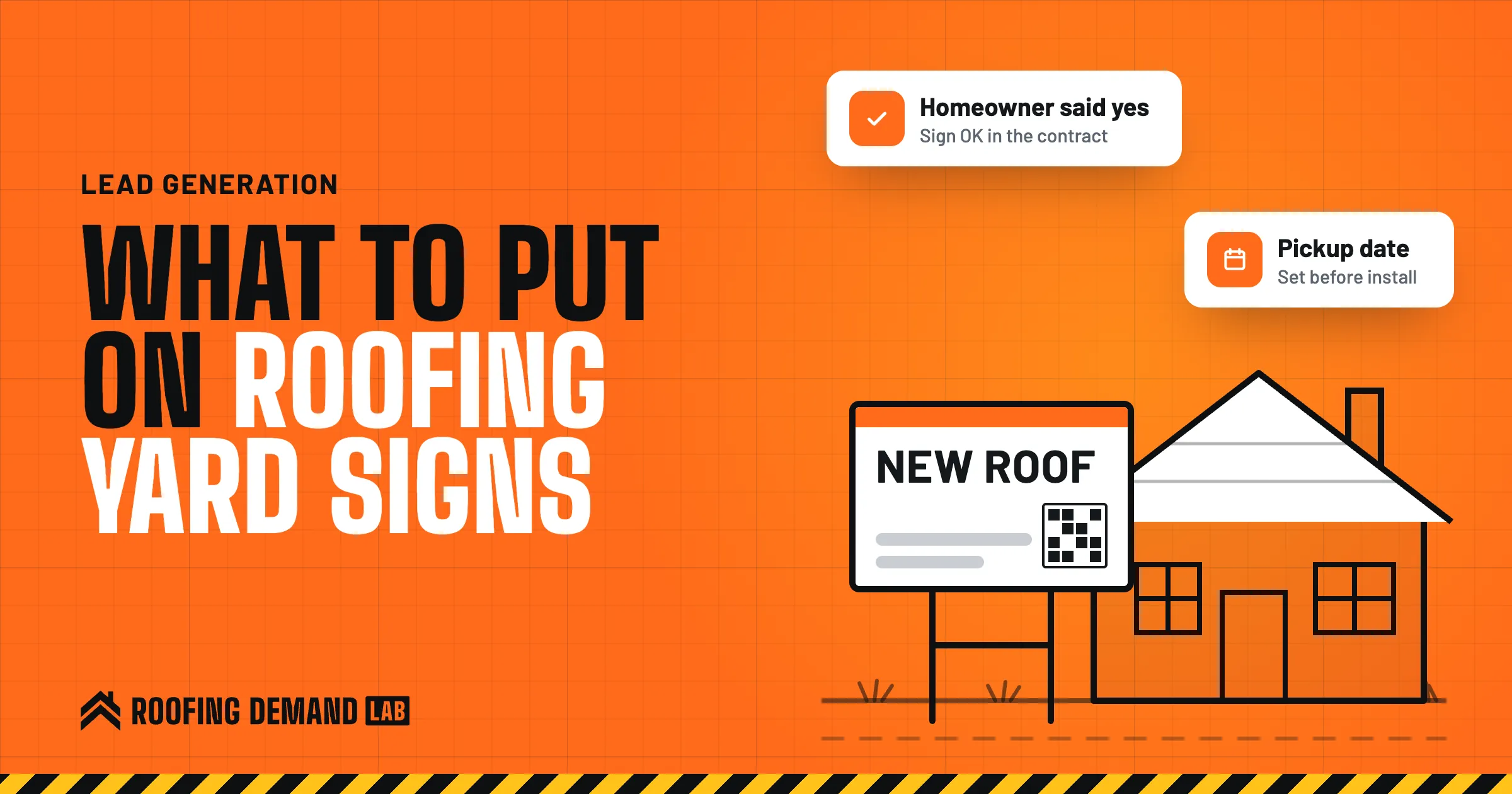
The easiest way is to put it in the paperwork. Add a line to your contract or job sheet asking whether you can place a sign during the job and for a set number of days after, with a box for yes or no. Some homeowners will say no, and that’s fine. Never push it, and never leave a sign up after someone asks you to take it down.
Place it where drivers can see it from the street without it blocking a driveway or a sidewalk. Near the mailbox on the side traffic comes from usually works. Then pull it on the date you agreed to, or have a plan for who picks it up.
2. After the job is done
The few days after a new roof goes on can be as useful as the tear-off. The roof looks its best, and neighbors who noticed the work are now looking at the result. A sign that says “New roof by” and your name connects the two.
If the homeowner agreed to it, leave the sign up for the time you both agreed on, then collect it. A sign that sits in a yard for months fades, tips over, and ends up advertising that you don’t come back for your stuff.
3. Other private property, only with the owner’s permission
A business owner near a busy intersection might let you put a sign on their lot, especially if you just did their roof. Get that permission in writing, and ask about any rules the property has.
Right-of-way rules
Strips along roads, medians, and utility poles are usually public right of way, even when they look like part of a yard. Texas, for example, says “a person may not place a sign on a public road or right of way unless authorized by state law or otherwise approved by the department,” and TxDOT may remove those signs without notice (TxDOT’s rules on illegal signs in the right of way (opens in a new tab)). Cities and counties often have their own sign ordinances on size, placement, and how long temporary signs can stay up, and HOAs may have rules too. Check with your city or county before you put signs anywhere other than a customer’s yard.
4. Not on every corner after a storm
After a big storm, some roofers put signs at every intersection in the hit neighborhoods. Those signs are often in the right of way, and plenty of them get pulled. Worse, they can make your company look like one of the crews that shows up after storms and disappears.
A better storm plan is the same as the normal one: a sign in the yard of every customer who says yes, so your name shows up next to real work on every street you’re on.
Insurance work
Keep insurance claim language off your signs unless you’ve checked your state’s rules. Florida, for example, bars residential contractors from offering a rebate, gift, cash, coupon, deductible waiver, or anything else of value in exchange for a roof inspection or an insurance claim, and it sets required warnings for certain ads about roof damage claims (Florida Statutes 489.147 (opens in a new tab)). Never put “We pay your deductible” or anything like it on a sign. This is general information, not legal advice. Check your state’s laws or ask an attorney.
How to tell whether your yard signs bring in work
Most roofers have no idea whether their signs do anything, because sign calls look like every other call. You can fix that with a little setup.
Give the sign its own address. Point a short web address or a QR code on the sign to a page on your site, and add campaign tags to the link. Google Analytics says that adding UTM parameters to the URLs you use in campaigns lets you see which campaigns sent traffic, and it recommends always using utm_source, utm_medium, and utm_campaign, in lowercase (Google Analytics help on UTM parameters (opens in a new tab)). Something like utm_source=yard-sign&utm_medium=print&utm_campaign=new-roof keeps it simple.
Send them somewhere useful. The page the sign points to should show your recent work and make it easy to request an inspection. Photos from that neighborhood are even better, with the homeowner’s permission. A roofing website with a page built for this is a lot more convincing than dropping people on your homepage.
Ask every caller. “How did you hear about us?” is low-tech and still works. Write the answer down every time, in the same place, so you can count it later.
Watch the texts. If your sign says “Text us,” reply to the person who texted you, but don’t add them to marketing texts without permission. FCC rules say commercial texts require written consent, and autodialed texts to a cell phone need prior consent (FCC guide to robocalls and robotexts (opens in a new tab)).
Give it a few months. If a sign address never gets a visit and no caller ever mentions a sign, change what’s on it or where you put it before you order more.
Make the sign part of a bigger job-site routine
A yard sign is one piece of marketing the job you’re already on. It works better with the others:
- Door hangers on nearby houses, saying you’re working on a roof on their street this week. Many towns require a permit for door-to-door solicitation, so check before your crew knocks or hangs anything.
- Photos for your Google Business Profile. Before, during, and after shots of the job show neighbors who look you up that you do real work nearby. Our roofing SEO page covers how your profile helps you show up on the map.
- A clean truck with your name on it, parked where people can see it. It reinforces the sign.
For the full list of ways to bring in work, see our guide on how to get roofing leads. If you’re still deciding what to call the company that goes on all of this, start with how to pick a roofing company name.
An honest note
A yard sign is cheap, but it’s not a lead machine on its own. Nobody can promise a set number of calls from signs, us included. Think of it as one more way to make your name familiar on the streets where you already work.
Questions roofers ask about yard signs
What size should a roofing yard sign be?
Print shops sell several standard sizes, and corrugated plastic on a wire stake is the usual choice for temporary job signs. Pick a size the homeowner is comfortable with, then test a proof by reading it from across the street. If you can’t read your name and the web address from there, the type is too small.
Where can I put yard signs for my business?
On private property, with the owner’s permission. For a roofer, that usually means the yard of a customer who agreed to it. Keep signs out of the public right of way, and check your city or county sign rules and any HOA rules before you place one.
How long should a roofing sign stay up after the job?
As long as the homeowner agreed to, and no longer. Agree on a pickup date when you ask for permission, put it in writing, and take the sign down on time.
Should a roofing yard sign have a QR code?
It can help, as long as the code is big enough to scan from the sidewalk and points to a page made for it. Pair it with a short web address for people driving by, since nobody scans a QR code from a moving car.