Lead generation9 min read
Roofing Flyers: What to Print and Where to Hand Them Out
Roofing flyers work best handed to a person, not tucked under a wiper. What to print, where to hand them out, and the local and USPS rules to check first.

In this article
Roofing flyers work when someone hands them to a person who’s already thinking about a roof. That’s the homeowner you just inspected, the couple at your booth at the home show, or the real estate agent who keeps getting asked “who should I call about the roof?” A flyer stuck under a windshield wiper in a grocery store parking lot reaches nobody in particular, and in a lot of towns it breaks the city code too.
A flyer also has something the rest of your print doesn’t: room. A business card holds a name. A door hanger holds a headline. A full sheet of paper can explain how your inspections work, what your warranty covers, and how to check you out, which is exactly what a careful homeowner wants to read after you leave.
The short answer
Use roofing flyers as a hand-to-hand piece: the leave-behind at every inspection, a stack at home shows and community events, and a version for partners like real estate agents. Print your company name, license number, real photos of your own work, one offer you’ll honor, and a tracked web address with a QR code. Never put flyers in or on mailboxes, check your city’s rules before putting them on cars or poles, and keep insurance-claim wording off them.
Where flyers fit with the rest of your roofing marketing materials
Most roofers end up with a small kit of printed pieces. Each one has a different job, and flyers get wasted when they’re asked to do another piece’s job.
| Piece | Where it goes | Its job |
|---|---|---|
| Business card | Handed over in person | Your name and how to reach you |
| Door hanger | Doorknobs near an active job | “Our crew is on your street this week” |
| Postcard | The mail, with postage | Reach every home around a finished job |
| Yard sign | The customer’s lawn, with permission | Show the street who did the work |
| Flyer | Handed to someone, or left where they’ve asked for it | Explain how you work and give them a reason to call |
So the flyer is the explainer. Ask it to be a door hanger too and you get a crowded sheet nobody finishes.
Where to hand out roofing flyers
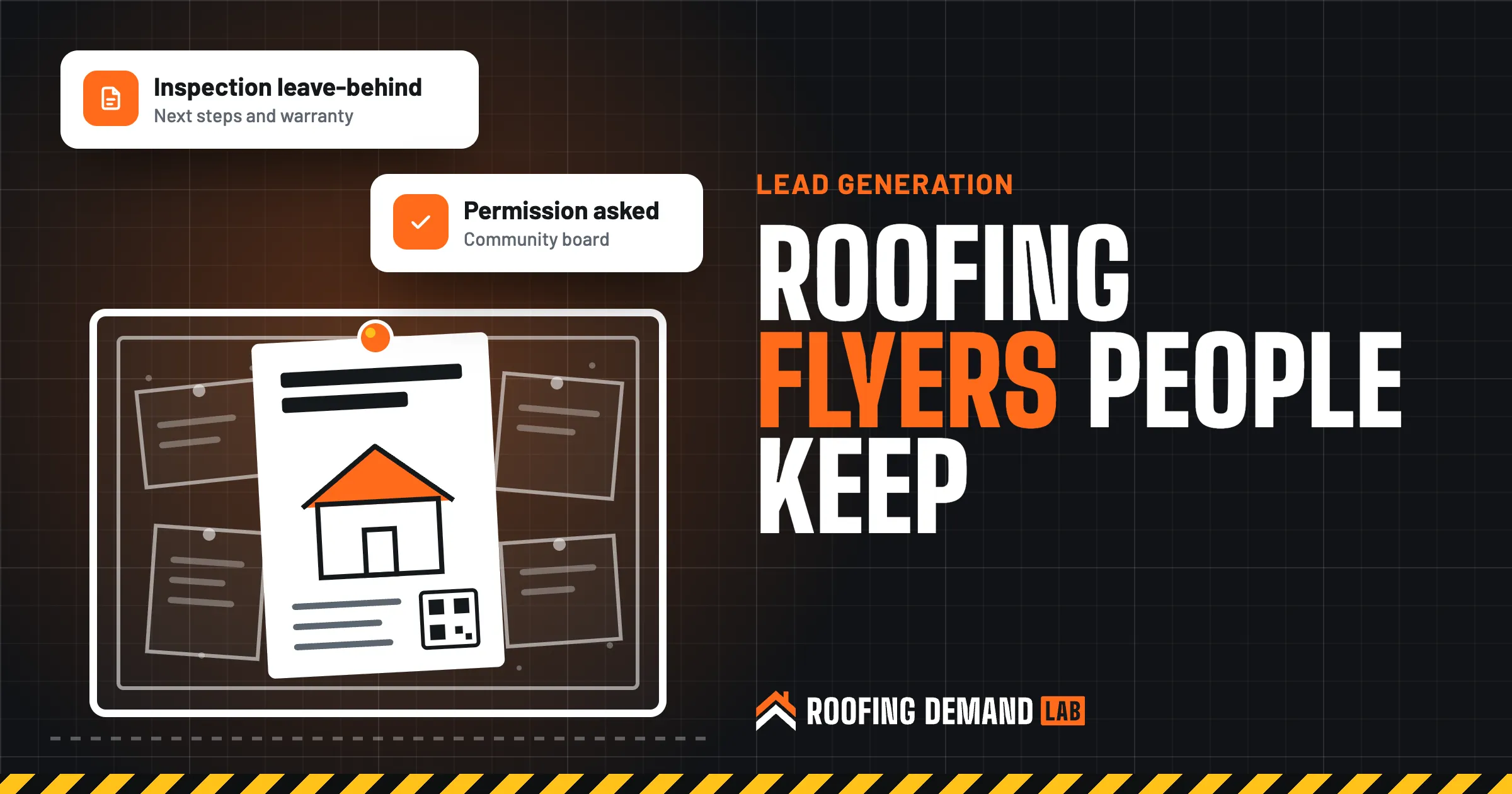
1. At every inspection, as the leave-behind
This is the flyer most worth printing. After an inspection, the homeowner usually talks it over with someone, and they may call two other roofers. Your flyer is what’s still on the counter when they compare.
Write this one for that moment. Cover what happens next, how long a typical estimate takes to arrive, what your workmanship warranty covers in plain terms, your license number, and where to read your reviews. Then hand it over with the estimate. Our roofing estimate template covers what goes in the estimate itself, so the flyer doesn’t have to repeat it.
2. At home shows, HOA meetings, and community events
A booth gives you people who walked up on purpose. That’s the best audience a flyer can get. Ask the organizer what you’re allowed to hand out and whether there’s a table for literature, and don’t push flyers at people walking past. Let them come to you, answer the question they asked, and hand the flyer over as the thing to read later.
For HOA meetings, ask the board first. Some welcome a contractor’s flyer on the info table. Others want nothing commercial.
3. A partner version for agents, inspectors, and property managers
Real estate agents, home inspectors, and property managers get asked about roofs all the time. A flyer written for them reads differently from a homeowner flyer: how fast you can get out for a pre-listing roof check, what your inspection report looks like, and how to send a client your way. Drop it off in person and ask if they’d like a few copies.
4. Counters and bulletin boards, with permission
Hardware stores, supply houses, and libraries often have community boards. Ask whoever runs the counter or the board before you pin anything up, and follow their rules on size and how long it stays.
5. On the streets around a job, carefully
Handing flyers out door to door is a different thing from hanging them on a knob. In Grapevine, Texas, the city’s solicitor permit page (opens in a new tab) says a permit isn’t needed to leave handbills as long as there’s no contact with the property owners, but door-to-door soliciting needs a permit, and solicitors can only go to homes from 9 a.m. to dusk Monday through Saturday, never on Sundays or federal holidays. Your city may have completely different rules. For doorknobs on a job street, a door hanger is usually the better tool anyway.
Where not to put roofing flyers
Three places to check before anyone leaves a flyer
Mailboxes are off limits. U.S. Postal Service rules say mail receptacles may be used only for matter bearing postage, and that covers items “placed upon, supported by, attached to, hung from, or inserted into” the box (USPS Domestic Mail Manual 508 (opens in a new tab)). Windshields are often restricted. Norfolk, Nebraska, for example, bars placing handbills or circulars with advertising on vehicles parked on public streets unless the owner has consented (Norfolk City Code Sec. 14-321 (opens in a new tab)). And utility poles are usually controlled. San Francisco allows postings only on some city-owned poles under size and placement rules, and says illegal postings in the public right of way can be removed and fined $100 to $500 (San Francisco Public Works on posting signs (opens in a new tab)). Check your own city’s code before you print a run meant for cars or poles.
If you want flyers in mailboxes, they have to go through the mail with postage. The postcards guide covers how USPS Every Door Direct Mail works for that.
What to print on a roofing flyer
A headline written for one reader
“Thinking about a new roof? Here’s how we work” is for the inspection leave-behind. “Pre-listing roof checks for agents” is for the partner flyer. A flyer that tries to talk to homeowners, agents, and commercial property owners at once ends up talking to nobody. Print separate versions. It’s cheap.
Photos of your own work
Use real photos of roofs your crew installed, ideally nearby. Skip stock photos, and never use another company’s job photos.
Your name, license number, and a way to check you out
Make the company name big. Then give a careful homeowner what they look for: license number, website, and the name to search for your reviews. Some states require the license number on ads. Florida says a contractor’s registration or certification number has to appear in advertisements “regardless of medium” (Florida Statutes 489.119 (opens in a new tab)). Your state licensing board can tell you what yours requires on printed ads.
One offer you’ll honor, and nothing you can’t back up
A free roof inspection is plenty. The FTC says advertising must be truthful and that “advertisers have proof before the ad runs” (FTC advertising FAQs for small business (opens in a new tab)). A flyer is an ad, so “Best roofer in town” is a claim you’d have to prove. The same guide says endorsements must reflect the honest experience of the person giving them, so only print a customer quote if it’s real, word for word, and used with that customer’s OK.
One tracked way to respond
A short web address plus a QR code that goes to a page built for the flyer, with the same offer and a short form to request an inspection. Tag the link so you can see it in your reports. Google Analytics says you should always use utm_source, utm_medium, and utm_campaign when you add these tags (Google Analytics help on custom URLs (opens in a new tab)). Give each version its own campaign, like utm_campaign=inspection-leave-behind and utm_campaign=home-show, so you can tell them apart.
Print the web address next to the code, too. The FTC has warned that scammers hide harmful links in QR codes and tells people to check the URL before opening one (FTC consumer alert on QR codes (opens in a new tab)). A visible address that matches your company name gives a cautious reader a reason to trust the code.
That landing page is the part roofers skip most, and without it there’s no way to tell whether the flyers did anything. A roofing website with room for campaign pages makes it easy.
Storm and insurance wording
Keep insurance claims off your flyers. Florida’s law on prohibited advertisements names flyers, door hangers, and business cards. It treats any written communication that encourages a homeowner to contact a contractor about a roof damage insurance claim as prohibited unless it carries specific disclosures, including that the homeowner is responsible for paying the deductible, and it bars offering a rebate, gift, coupon, or deductible waiver in exchange for a roof inspection or a claim (Florida Statutes 489.147 (opens in a new tab)). Other states have their own rules. This is general information, not legal advice, so check your state’s laws or ask an attorney before you print anything about storms or claims.
When someone responds to a flyer
Answer fast and book the inspection. If they texted you, reply to their text. But before you put anyone on marketing texts, get their consent. The FCC says commercial texts require written consent (opens in a new tab), and its rules ban autodialed texts to a cell phone unless the owner agreed to get them. A checkbox on the flyer’s landing page form is a common way to ask. Our roofing sales guide covers what to do once you’re standing in their driveway.
How to tell if roofing flyers are working
Keep three numbers for each version:
- Flyers out How many went to inspections, events, and partners, and where.
- Responses Tagged page visits, form fills, and callers who mention the flyer. Ask every caller how they heard about you.
- Inspections booked The only number that pays for the printing.
Give each version a few months, since a leave-behind may sit on a counter for weeks before someone calls. If one version produces nothing, change one thing, like the headline or the offer, and try again.
Plenty of people won’t scan the code. They’ll search your company name, and if that turns up a thin website and a handful of reviews, the flyer did its job and the rest of your marketing lost the inspection. That’s the gap our roofing SEO work is built to close. For the full list of ways roofers bring in work, see how to get roofing leads.
An honest note
Nobody can promise a set number of calls from flyers, us included. A good flyer can make your company easier to trust and easier to find again, and that’s its job.
Questions roofers ask about flyers
Can you put roofing flyers in mailboxes?
No. USPS rules say mailboxes may be used only for matter bearing postage, and that includes anything placed on, attached to, or hung from the box. To reach mailboxes, mail it with postage, for example through Every Door Direct Mail.
Can you put flyers on car windshields?
It depends on the city, and many restrict it. Norfolk, Nebraska, for one, bars advertising handbills on vehicles parked on public streets without the owner’s consent. Check your city’s code, and since a windshield flyer reaches nobody in particular, it’s rarely worth the risk.
What should a roofing flyer say?
A headline for one kind of reader, real photos of your work, your company name and license number, one offer you’ll honor, and a tracked web address with a QR code. Leave off claims you can’t prove, made-up testimonials, and anything about insurance claims.
Do roofing flyers work?
They can, mostly when they’re handed to someone who’s already thinking about a roof, like a homeowner after an inspection or a visitor at your booth. There’s no reliable average to quote, so track your own: count what goes out, tag the link, and ask every caller how they found you.