Lead generation9 min read
Roofing Door Hangers: What to Say and Where to Hang Them
Roofing door hangers work best on the streets around a job you are doing. What to print, where to hang them, and the local and USPS rules to check first.

In this article
- Where roofing door hangers fit
- Check the local rules before anyone hangs one
- What to put on a roofing door hanger
- How to hang them without annoying the street
- When a neighbor responds
- How to tell if door hangers are working
- Make door hangers part of the job-site routine
- Questions roofers ask about door hangers
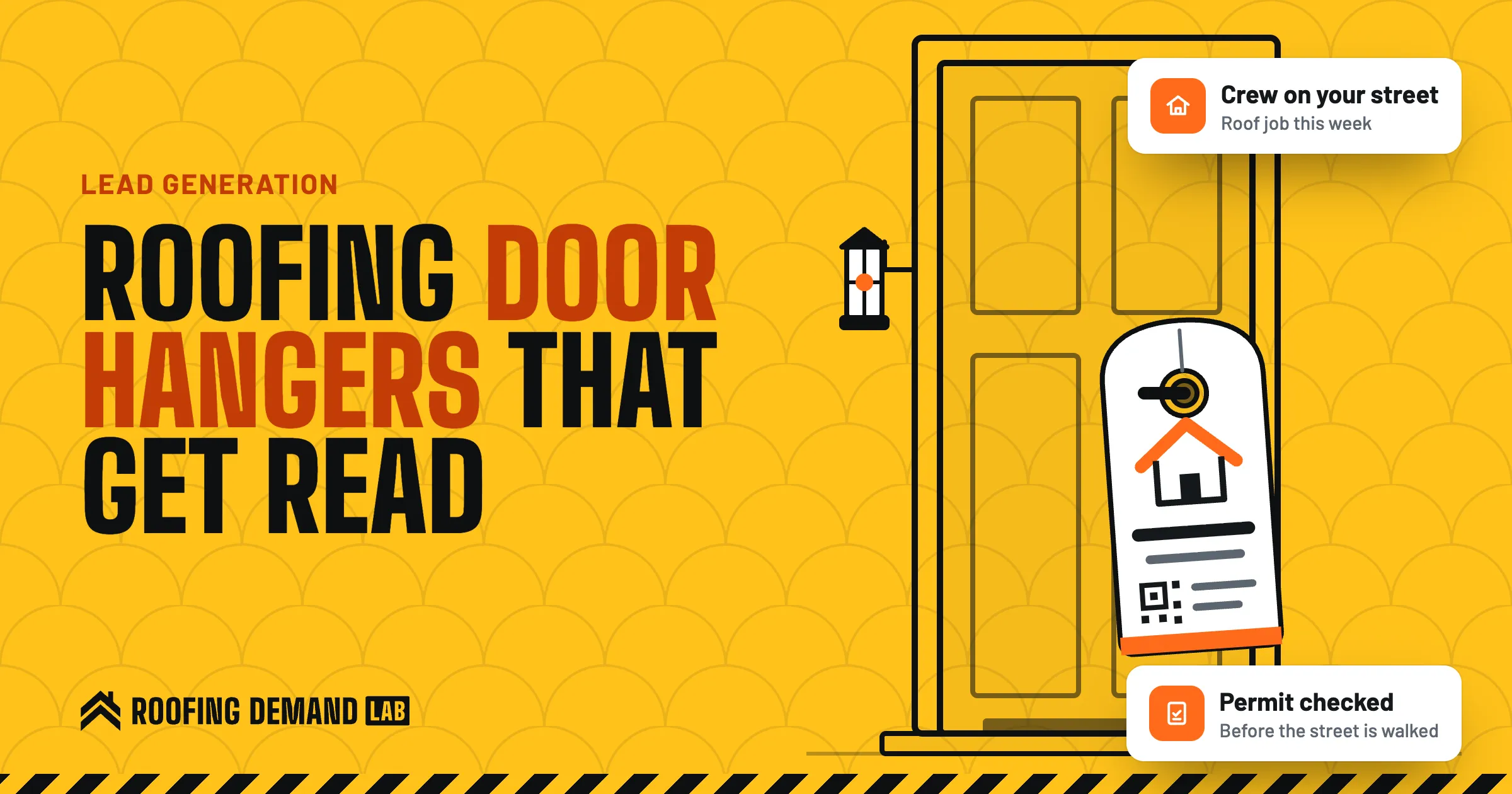
Roofing door hangers work when they have a reason to be on that door. A hanger that says “We’re replacing the roof on the gray house down your street this week” gives the neighbor something they can check by looking out the window. A hanger that says “Need a roof? Call us!” left on 500 doors in a subdivision you’ve never worked in gives them something to throw away.
Being specific also keeps you from looking like a scammer. The FTC’s advice on avoiding home improvement scams (opens in a new tab) warns homeowners about people who knock looking for business because they’re “in the area.” A vague hanger reads a lot like that. One tied to a real job, with your name and license number, reads like the opposite.
The short answer
Hang door hangers on the houses that can see a job you’re doing, and say so on the hanger. Keep it to a short headline about their street, your company name and license number, one offer you’ll honor, and one tracked way to respond. Check your city’s solicitation and handbill rules before anyone walks a street, skip any house with a no-soliciting sign, and never put anything in or on a mailbox.
Where roofing door hangers fit
A door hanger is a job-site tool. It works best on the few streets where your crew, trucks, and dumpster are already doing the advertising:
- The houses around an active job. Same street, across the street, and the backyards that look onto it. Those neighbors are watching the tear-off anyway. Ask your customer first if you can mention their job on the street, and never print their name or address.
- The day you finish. Pair the hanger with the yard sign so the sign and the hanger tell the same story.
- Next to a repair you’re already doing. Even a small job puts your truck in the driveway for an afternoon.
Where it flops: neighborhoods where you have no job and no reason to be there. That’s where a hanger looks most like the “in the area” knock the FTC warns about.
The courtesy hanger
Here’s an easy one to add. Before a tear-off, hang a heads-up on the closest houses: which days the crew will be there, that there’ll be noise and a dumpster, and who to contact if a nail ends up in their yard. It’s a favor first and an ad second. A neighbor who got a polite warning is less likely to be annoyed by day two, and the hanger still carries your name, license number, and an offer to look at their roof.
Check the local rules before anyone hangs one
Whether a door hanger counts as soliciting depends on where you are. Two Texas cities a short drive apart show how much it can vary.
| Rule | Grapevine, Texas | Benbrook, Texas |
|---|---|---|
| Leaving a hanger, no contact with the owner | No permit needed | Handbill registration with the city first |
| Knocking or ringing the bell | Solicitor’s permit required | Solicitor’s permit required |
| Hours | Solicitors only from 9 a.m. to dusk, never on Sundays or federal holidays | No soliciting or handbill distribution from 9 p.m. to 9 a.m. |
| No-soliciting signs | Residents can post a sign or join the city’s Do-Not Solicit list | No soliciting or leaving handbills where a sign says solicitors aren’t welcome |
| Other | Distributors wear a traffic safety vest, and vehicles need a sign identifying the person or company |
Grapevine’s solicitor permit page (opens in a new tab) says leaving handbills on doorknobs isn’t soliciting and needs no permit, as long as there’s no contact with the owners. Benbrook’s door-to-door solicitation page (opens in a new tab) regulates commercial handbill distribution with the rules above. Same state, same paper, two answers.
So before a crew walks a street, check your city’s code or call the office that issues solicitor permits. Ask two questions: do we need a permit or registration to leave handbills, and do we need one to knock? If you work in several towns, keep a cheat sheet, because the answers won’t match.
Two rules that apply almost everywhere
Never put a hanger in, on, or hanging from a mailbox. U.S. Postal Service rules say mail receptacles may be used only for matter bearing postage, including anything “placed upon, supported by, attached to, hung from, or inserted into” the box (USPS Domestic Mail Manual 508 (opens in a new tab)). And skip any house with a no-soliciting sign, even if your town’s code doesn’t mention hangers. A hanger on that door does you more harm than good.
What to put on a roofing door hanger
A hanger gets a glance on the way inside. That’s room for a headline, a name, one offer, and one way to respond.
1. The reason you’re on their street
Lead with the job: “Our crew is replacing a roof on Birch Lane this week.” Use the street, not the house number. Then one line on why it matters to them: houses on the same street may have been built around the same time, so their roof could be about as old as the one you’re replacing.
2. Your name, and a way to check you out
Make the company name big. Then add what a careful homeowner looks for: your license number, your website, and the name they’d search to read your reviews. Some states require the license number. Florida says a contractor’s registration or certification number has to appear in any advertisement “regardless of medium” (Florida Statutes 489.119 (opens in a new tab)). Your state board can tell you what yours requires on printed ads. Our roofing business cards guide covers the same checklist for cards.
3. One offer you’ll actually honor
A free roof inspection while the crew is nearby is plenty. The FTC says advertising has to be truthful and that advertisers need proof before the ad runs (FTC advertising FAQs for small business (opens in a new tab)). A hanger is an ad, so “Best roofer in the county” is a claim you’d have to back up. Leave out star ratings and customer quotes unless they’re real, word for word, and used with the customer’s OK.
4. One tracked way to respond
For a lot of roofers that’s a short web address plus a QR code that goes to a page built for the hanger, with the same offer and a short form to request an inspection. Tag the link so it shows up in your reports. Google Analytics says to always use utm_source, utm_medium, and utm_campaign when you add these tags (Google Analytics help on UTM parameters (opens in a new tab)). Something like utm_source=door-hanger&utm_medium=print&utm_campaign=birch-lane keeps each street separate.
That page often gets skipped, and without it there’s no way to tell whether the hangers did anything. A roofing website with room for campaign pages makes it easy.
Storm and insurance wording
Keep insurance claims off your door hangers. Florida’s law on prohibited advertisements lists door hangers by name. It treats any written communication that encourages a homeowner to contact a contractor about a roof damage insurance claim as prohibited unless it carries specific disclosures, including that the homeowner is responsible for the deductible, and it bars contractors from offering a rebate, gift, coupon, or deductible waiver in exchange for a roof inspection or a claim (Florida Statutes 489.147 (opens in a new tab)). Other states have their own rules. This is general information, not legal advice, so check your state’s laws or ask an attorney before you print anything about storms or claims.
How to hang them without annoying the street
- Daylight only, and inside your city’s hours. Benbrook’s 9 p.m. to 9 a.m. ban is one example.
- Stay on the sidewalk and front walk. Not across lawns or through side gates.
- Hang it firmly on the knob. A hanger blowing down the street is litter with your name on it.
- Send someone who can answer a question. If a homeowner opens the door, that person is your company for the next minute, and if your city requires a permit for any contact, they need one.
- Count what you hang. Street, date, and how many. You’ll need it later.
When a neighbor responds
Once someone calls, texts, or fills out the form, the rules shift to how you follow up. Answer fast and book the inspection. If they texted you, reply to their text. But before you add anyone to marketing texts, get their consent. The FCC says commercial texts require written consent (opens in a new tab), and its rules ban autodialed texts to a cell phone unless the owner agreed to get them.
If it turns into a signed job at their kitchen table, know the FTC’s Cooling-Off Rule. For sales of $25 or more made at a buyer’s home, it can give the buyer until midnight of the third business day to cancel, and the seller has to tell the buyer about that right at the time of the sale (FTC on the Cooling-Off Rule (opens in a new tab)). Many states add their own contract rules, so check yours. And never push for a same-day decision, which the FTC scam page also lists as a warning sign. Our roofing sales guide covers an inspection process that doesn’t lean on pressure.
How to tell if door hangers are working
Three numbers settle it: hangers out (from your count), responses (tagged page visits, form fills, and callers who mention “the thing on my door,” so ask every caller how they heard about you), and inspections booked. Give each street a few weeks, since some people keep the hanger and call later. If a street produced nothing, change one thing next time, like the headline or the offer, not everything at once. The postcards guide uses the same tracking setup for mail.
Make door hangers part of the job-site routine
On their own, door hangers are a small tactic. Repeated on every job, they add up:
- Day one Courtesy hangers on the closest houses.
- The day you finish Yard sign up, and hangers on the next ring of houses.
- A week or two later Postcards to the same streets, and a review request to the customer. Our guide to getting more Google reviews the right way covers what Google and the FTC allow.
Plenty of neighbors won’t scan the code. They’ll search your name, and if they find a thin website and few reviews, the hanger got their attention and your online presence lost the inspection. Our roofing SEO work is built for that moment. For the full list of ways roofers bring in work, see how to get roofing leads.
An honest note
Nobody can promise a set number of calls from door hangers, us included. They can make your name familiar on the streets where you already work, and that’s about it.
Questions roofers ask about door hangers
Are door hangers considered soliciting?
It depends on the city. Grapevine, Texas, says leaving handbills on doorknobs with no contact isn’t soliciting, while nearby Benbrook requires handbill distributors to register. Check your city’s code or call the office that issues solicitor permits.
Can you put door hangers on mailboxes?
No. USPS rules say mailboxes may be used only for matter bearing postage, and that covers anything placed on, attached to, or hung from the box. Use the door handle or skip the house.
Can I leave a door hanger at a house with a No Soliciting sign?
Don’t. Some cities, like Benbrook, bar leaving handbills where a sign says solicitors aren’t welcome. Even where the code is silent, ignoring the sign tells that homeowner what kind of company you are.
Do roofing door hangers work?
They can, mostly on the streets around a job you’re doing, where neighbors can see your crew. There’s no reliable average to quote, so track your own: count the hangers, tag the link, ask every caller how they found you, and keep what works.