Lead generation9 min read
Roofing Postcards: When Direct Mail Still Works for Roofers
Roofing postcards work best on streets where you just did a roof. How to pick the homes, what to print, how EDDM works, and how to tell if the cards paid off.

In this article
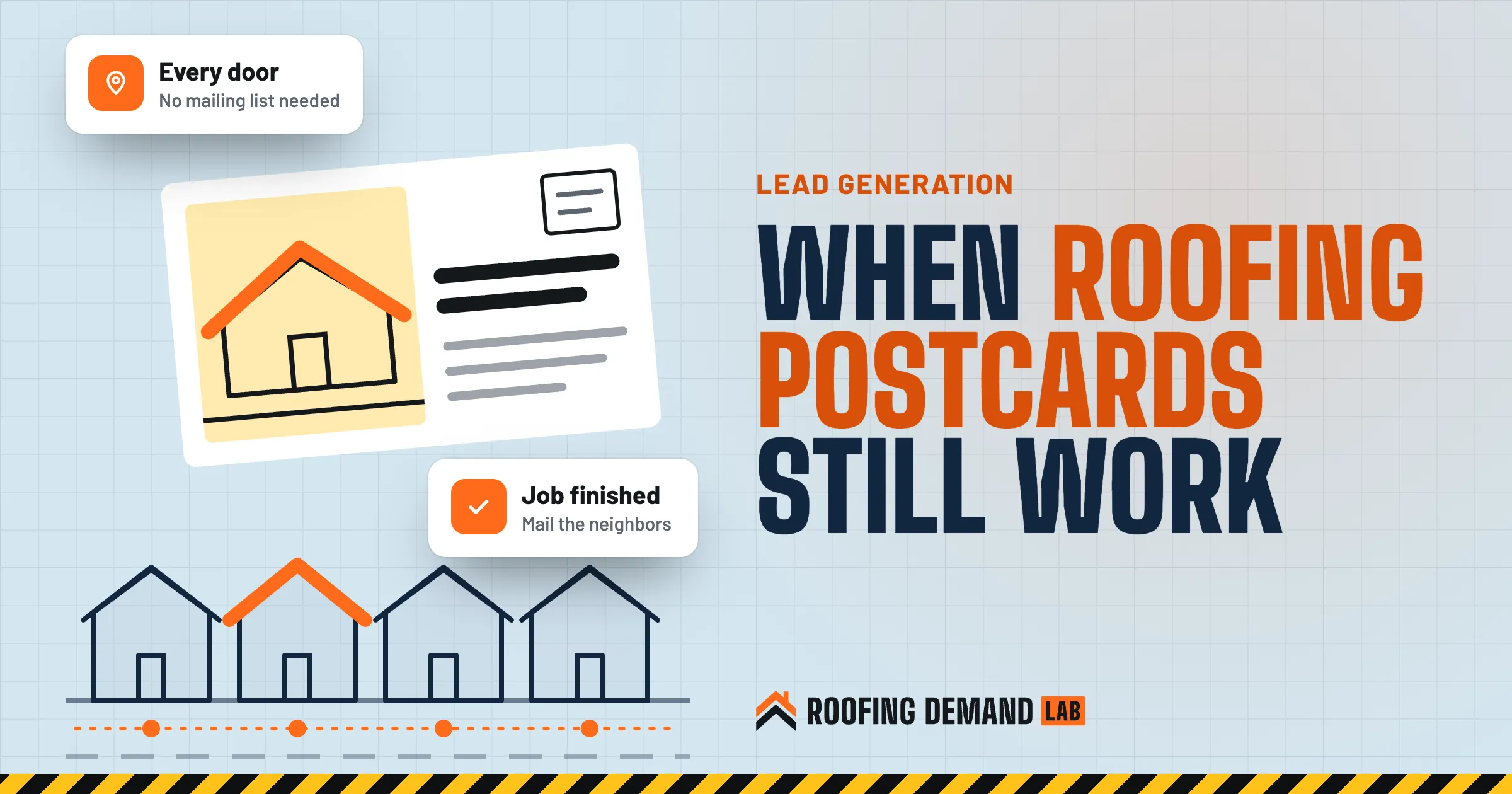
Roofing postcards still work, but not the way most print shops sell them. A card mailed cold to a whole ZIP code is competing with every pizza coupon in the mailbox. A card mailed to the 300 homes around a roof you just finished has something the pizza coupon doesn’t: the neighbors have already seen your crew, your trucks, and maybe your yard sign. The postcard tells them who did it.
That’s the whole idea of this guide. The top results for this topic are template galleries, and a nice template is the easy part. The hard part is picking the right homes, putting the right few things on the card, and knowing afterward whether it brought in anything.
The short answer
Mail postcards to the streets around jobs you’ve just finished, and to your own past customers, instead of blanketing a whole town. Keep the card simple: a photo of real work nearby, your name, one offer that’s true, one way to respond, and your license number where your state requires it. USPS Every Door Direct Mail lets you reach every address on a carrier route without a mailing list, and a dedicated web address on the card lets you see what it brought in.
When roofing postcards work and when they don’t
Direct mail is a timing tool. Nobody needs a roof because a postcard showed up. People need a roof because theirs is old, leaking, or got hit by hail, and the postcard is there when they start thinking about it.
So the best mailings ride on something that’s already happening on that street:
- A job you just finished. The neighbors watched the tear-off. Houses on the same street were often built around the same time, so their roofs may be about as old as the one you replaced.
- Your past customers. People who already paid you are the warmest list you have. A yearly check-in card keeps your name on the fridge for the day a neighbor asks who did their roof. Our guide to setting up a roofing referral program covers how to give them a reason to pass your name along.
- A season or a storm. Before the rainy or freeze season, a card about inspections gives people a nudge. After a storm, be careful with your wording (more on that below).
And here’s when they tend to flop: one-time blasts to a random ZIP code with no follow-up, cards that look like every other contractor’s card, and mailings with no way to tell where the calls came from. If you can’t measure it, you can’t tell a bad list from a bad card, and you end up guessing.
How EDDM works for roofers
Every Door Direct Mail (EDDM) is the U.S. Postal Service’s program for mailing to every address on the carrier routes you choose. You don’t need a mailing list. USPS describes it as a way to promote a small business in your local community, and its online tool lets you pick routes on a map and filter them by things like age, income, and household size, using U.S. Census Bureau data (USPS Every Door Direct Mail (opens in a new tab)).
There are two versions:
| EDDM Retail | EDDM BMEU | |
|---|---|---|
| Who it’s for | Small businesses mailing locally | Large-volume mailers |
| Permit | No special mailing permit needed | Paid with a bulk mailing permit |
| Volume | At least 200 pieces, up to 5,000 per day per ZIP Code | No volume limit |
| Drop-off | Your local Post Office | A mail processing center |
That table comes from the USPS EDDM page (opens in a new tab), which also lists the per-piece postage. When we checked in October 2026, it listed EDDM Retail flats at $0.26 per piece. Postage changes, so check the current rate before you budget, and remember that printing is a separate cost.
Size rules for EDDM
A standard 4 by 6 inch postcard is too small for EDDM. The Postal Service’s mailing standards say an EDDM Retail piece must weigh no more than 3.3 ounces and be longer than 10-1/2 inches, taller than 6-1/8 inches, or thicker than 1/4 inch (USPS Domestic Mail Manual 143 (opens in a new tab)). Use the size checker in the EDDM online tool, and get your printer to confirm the format, before you order.
EDDM’s strength is also its limit. It reaches every door on a route, renters and apartments included, and you can’t pick out the house with the 25-year-old roof. That’s fine when the route is a neighborhood of similar houses around your job. It’s a waste when the route is half apartments. Look at the route on the map before you check the box.
For past customers, you already have the addresses, so you can mail them as regular addressed mail without EDDM.
What to put on a roofing postcard
A postcard gets a few seconds at the mailbox, usually on the walk to the trash can. You get a photo, a headline, and one reason to act.
1. A photo of real work, close to home
Use a photo of a roof your crew actually did, ideally in that neighborhood, with the homeowner’s permission. A stock photo of a perfect roof in a place that looks nothing like your town tells the reader nothing about you. “We just finished a roof on Maple Street” with a photo of that roof tells them a lot.
2. A headline about them, not you
“Your neighbor just got a new roof” beats “Family owned since 2009.” The reader cares about their own house. Mention the street or the neighborhood if you can.
3. One offer that’s true
A free inspection, a fall roof check, or a quick estimate is plenty. Whatever you print has to be something you’ll actually honor, with the details spelled out. The FTC says advertisers must have proof to back up their claims before an ad runs (FTC advertising FAQs for small business (opens in a new tab)), and a postcard is an ad. “Best roofer in town” and “lowest prices guaranteed” are claims. So is a star rating or a quote from a customer. Only print reviews that real customers wrote, word for word, with their OK.
4. One way to respond
Pick the response you most want: a short web address or a phone number. A QR code is fine as an extra, as long as it goes to a page made for the card. More on that page in a minute.
5. Your name and license number
Make your company name big enough to recognize the next time they see your truck. Then check your state’s ad rules. Florida, for example, says a contractor’s registration or certification number has to appear in each advertisement “regardless of medium” (Florida Statutes 489.119 (opens in a new tab)). Other states have their own rules, so ask your state contractor licensing board what has to be on a printed ad.
Storm and insurance wording
Be careful with any card that talks about storm damage and insurance claims. Florida law treats a written communication that encourages a homeowner to contact a contractor about making a roof damage insurance claim as a prohibited advertisement unless it carries specific disclosures, including that the homeowner is responsible for the deductible, and it bars contractors from offering a rebate, gift, coupon, or deductible waiver in exchange for a roof inspection or a claim (Florida Statutes 489.147 (opens in a new tab)). Never print “We cover your deductible” or anything like it. Other states have their own rules. This is general information, not legal advice, so check your state’s laws or talk to an attorney before you mail anything about storms or claims.
How to tell if your postcards worked
Most roofers can’t say whether a mailing paid for itself, because postcard calls look like every other call. Set up these three things before the cards go out.
Give the card its own web address. Point the address or QR code on the card to a page on your site and add campaign tags to the link. Google Analytics says to always use utm_source, utm_medium, and utm_campaign when you add these tags to a URL (Google Analytics help on UTM parameters (opens in a new tab)). Something like utm_source=postcard&utm_medium=direct-mail&utm_campaign=maple-street keeps each mailing separate in your reports.
Make the page match the card. The page should show the same photo, the same offer, and a short form to request an inspection. Dropping people on your homepage makes them hunt. A roofing website with a page built for each mailing does a better job of turning a curious neighbor into a booked inspection.
Ask every caller how they heard about you. Write the answer down in the same place every time. At the end of the month, count how many said “a postcard,” and compare that to what you spent on printing and postage.
Give each mailing a few weeks, since some people keep the card and call later. Then keep doing what got calls, and change the route, the photo, or the offer on what didn’t.
Make postcards part of the job-site routine
Postcards work best as one piece of a routine you repeat on every job:
- Before the job Ask the homeowner if you can put up a yard sign and use photos of their roof. Our roofing yard signs guide covers what to put on the sign and where it’s allowed.
- During the job Take good before, during, and after photos. They feed the postcard, your website, and your Google Business Profile.
- Right after Mail the streets around the job while the work is fresh in the neighbors’ minds.
- Later Ask the customer for an honest review, and add them to your yearly past-customer mailing. Our guide to getting more Google reviews the right way covers what Google and the FTC allow.
Mail also works best when the neighbor who gets the card can look you up and like what they find. If they search your name and see a thin website or no reviews, the card did its job and your online presence lost the inspection. Our roofing SEO work is built to fix that part. For the full list of ways roofers bring in work, see how to get roofing leads.
An honest note
Nobody can promise a set number of calls from a mailing, us included. Postcards can help your name feel familiar on the streets where you already work. They’re not a substitute for a good website, real reviews, and fast follow-up when someone calls.
Questions roofers ask about postcards and direct mail
Is EDDM worth it for roofers?
It can be, when you use it on purpose. EDDM fits well for mailing the routes around a finished job, where the houses are similar and the neighbors have seen your work. It’s a weaker fit for blanketing a town with no reason behind it, and it’s only worth repeating if you track the results.
How much does EDDM cost per home?
The USPS EDDM page lists the per-piece postage, which was $0.26 for EDDM Retail flats when we checked in October 2026. Printing is extra and varies by size, paper, and quantity. Check the current postage on the USPS site and get a printing quote before you plan a mailing.
What size postcard do you need for EDDM?
Bigger than a regular postcard. USPS mailing standards say an EDDM Retail piece has to be longer than 10-1/2 inches, taller than 6-1/8 inches, or thicker than 1/4 inch, and weigh no more than 3.3 ounces. Check your size in the EDDM tool before you print.
Do I need a mailing list to send roofing postcards?
Not for EDDM. It delivers to every address on the carrier routes you choose, so you pick routes on a map instead of buying a list. For past customers, use the addresses you already have.