Lead generation9 min read
Roofing Email Marketing: What to Send Past Customers
Roofing email marketing works best with people who already hired you. Six emails to send past customers, when to send them, and the CAN-SPAM basics.

In this article
Roofing email marketing is mostly about the people who already paid you. A roof replacement is a once-in-a-long-while purchase, so your customers won’t need another one from you for years. But they’ll have a leak after a windstorm, a neighbor who asks who did their roof, and a review they meant to write and forgot. A handful of useful emails a year keeps you the roofer they think of when any of that happens.
Is email a waste of time for roofers? It is if you treat it like a lead machine and blast a bought list. It isn’t if you treat it like a follow-up system for jobs you’ve already done.
The short answer
Email your own customers and the people who asked you for an estimate, not bought lists. Send a job wrap-up with photos and warranty details, a review request, a one-year check-in, a note before your storm season, a careful check-in after big storms, and a yearly referral reminder. Any email that promotes a service has to follow the CAN-SPAM Act: accurate sender details, an honest subject line, your postal address, and a working unsubscribe link.
Why email works differently for roofers
A restaurant can email a coupon every week because people eat every day. Nobody buys a roof every week. For a roofer, the value of an email list isn’t repeat sales. It’s the stuff that happens around the roof:
- Referrals. Your customer’s neighbors and family will need roofs long before your customer does.
- Repairs. Flashing, gutters, a few blown-off shingles. Small jobs that keep the relationship alive.
- Reviews. The best time to ask is right after the job, and email makes the ask easy to act on.
- Storm season. When hail or high wind hits, past customers want to hear from someone they already trust.
Email has one more advantage over social media: the list is yours, not a platform’s.
Build the list the honest way
Your list should be people who gave you their email address and know you’ll use it. For most roofers, that’s two groups: customers and people who requested an estimate.
Collect the address on your estimate form and contract, with a line saying you’ll send job updates and warranty information, plus a checkbox for occasional roof tips. The same line belongs on the inspection form on your roofing website.
Then skip the shortcuts. Google’s sender guidelines say plainly: don’t buy email addresses from other companies, and don’t send messages to people who didn’t sign up to get them (Google email sender guidelines (opens in a new tab)). The same page asks senders to keep their spam rate in Google’s Postmaster Tools below 0.3%, and a list of strangers who never asked to hear from you is a fast way to get flagged.
People a customer refers to you are a separate case. They didn’t ask to hear from you yet, so reach out personally instead of adding them to your list. Our guide to setting up a roofing referral program covers that handoff.
Texting is a different set of rules
If you text customers instead of emailing, the FCC says commercial texts require written consent, and autodialed texts to a cell phone require prior consent (FCC guide to robocalls and texts (opens in a new tab)). Get consent in writing, usually in your contract, before you add anyone to texts, and have an attorney look at any texting software you use.
Six emails to send past customers
You don’t need a newsletter. You need a short set of emails tied to moments that matter to the homeowner.
1. The job wrap-up
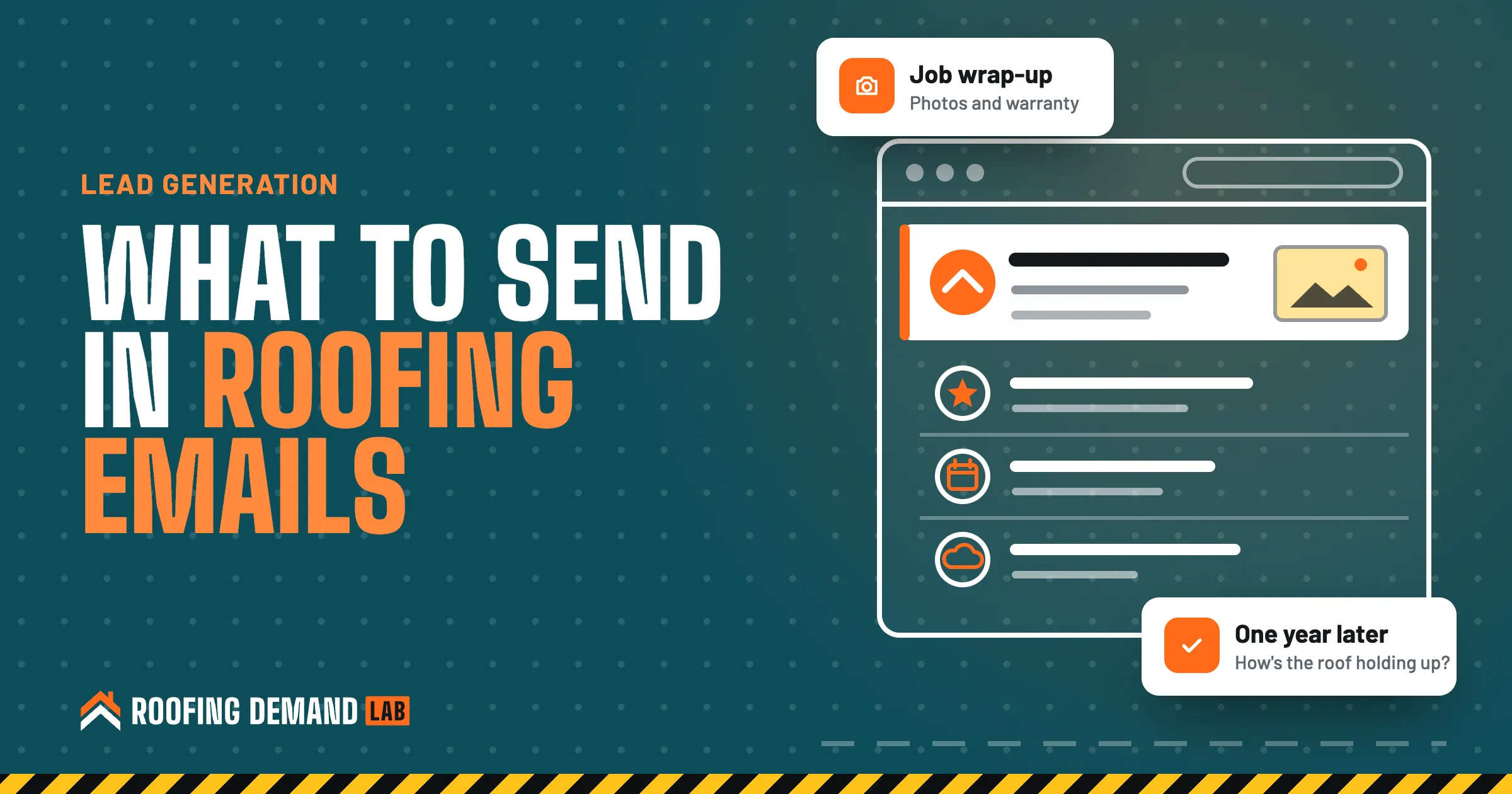
Send this within a day or two of finishing: before and after photos, the materials used, your workmanship and manufacturer warranty details, the final invoice, and what to watch for (like a lifted shingle seen from the ground).
Keep this one about the job only. The FTC’s CAN-SPAM guide says a message whose content is only about things like warranty, recall, or safety information on something the recipient bought counts as transactional, and transactional messages are exempt from most of the law’s rules (FTC CAN-SPAM compliance guide (opens in a new tab)). Add a gutter guard promo to the bottom and the same guide’s primary purpose test may make it a commercial email. So send promotions separately.
2. The review request
Ask in person at the final walkthrough, then send the review link the same day. Ask every customer. Google’s policy says businesses must not selectively ask happy customers for positive reviews or discourage negative ones, and must not offer incentives such as discounts or free services in exchange for a review (Google’s policy on fake engagement and rating manipulation (opens in a new tab)). Our guide to getting more Google reviews the right way has the full process.
3. The one-year check-in
A year after the job, send a short note: how’s the roof holding up, what to look for after a big storm, and reply if anything looks off. Offering a gutter cleaning or roof check is fine, as long as you follow the commercial email rules below.
4. Before your storm season
Time this to your region: before hurricane season, the spring hail months, or the first hard freeze. Tell people what they can check safely from the ground (missing shingles, clogged gutters, ceiling stains) and remind them not to climb up themselves. If you offer a pre-season inspection, say what it includes and only offer what you’ll honor.
5. After a big storm
A plain check-in after hail or high winds is fine: if you see shingles in the yard or a new ceiling stain, here’s how to reach us.
Storm and insurance wording
Be careful with any email that talks about storm damage and insurance claims. Florida’s statute on roofing contractor advertising covers written and electronic communications, emails included, that encourage a homeowner to contact a contractor about making a roof damage insurance claim, and requires specific disclosures, including that the homeowner is responsible for any insurance deductible. It also bars contractors from offering a rebate, gift, coupon, or deductible waiver in exchange for a roof inspection or a claim (Florida Statutes 489.147 (opens in a new tab)). Never write “we’ll cover your deductible” or anything like it. Other states have their own rules. This is general information, not legal advice, so check your state’s laws or talk to an attorney before you send storm emails.
6. The yearly referral reminder
Once a year, thank customers and remind them how referrals work, if you have a program. One email, written like a person, with a link to your referral terms.
Here’s how the six fit together over a customer’s first year:
| When to send it | Likely type under CAN-SPAM | |
|---|---|---|
| Job wrap-up | 1 to 2 days after the job | Transactional, if it’s only about the job |
| Review request | The day of the final walkthrough | Treat as commercial if it promotes anything |
| One-year check-in | 12 months after the job | Commercial if it offers a service |
| Before storm season | Once a year, timed to your region | Commercial |
| After a big storm | Within a few days of the storm | Commercial if it offers an inspection |
| Referral reminder | Once a year | Commercial |
When in doubt, treat it as commercial and follow every rule. It costs you a footer.
The CAN-SPAM rules every roofer should know
CAN-SPAM basics
The FTC’s guide lists the main requirements for commercial email: accurate “From” and “Reply-To” information, a subject line that matches the message, a clear disclosure that the message is an ad, a valid physical postal address, and a clear way to opt out of future marketing emails. Opt-out requests have to be honored within 10 business days, your opt-out link has to keep working for at least 30 days after you send, and you can’t sell or transfer the address of someone who opted out. Hiring an email company doesn’t move your legal responsibility to them, and the guide says each separate email in violation can bring a penalty of up to $53,088 (FTC CAN-SPAM compliance guide (opens in a new tab)). This is general information, not legal advice.
Note that past customers get no special pass. A promotional email to someone who hired you is still commercial, and “Your roof warranty” on top of a sale email is the kind of subject line mismatch the rule is about.
On the technical side, Google’s sender guidelines require every sender to set up SPF or DKIM authentication for their sending domain. Anyone sending more than 5,000 messages a day to Gmail also needs DMARC and one-click unsubscribe (Google email sender guidelines (opens in a new tab)). Most roofers are nowhere near 5,000 a day, but set up authentication on your domain anyway so your emails have a better shot at the inbox. Many email tools walk you through it.
How often roofers should email
Less often than you’d think. The six emails above come out to a handful a year per customer, and that’s plenty. A monthly newsletter only makes sense if you have something worth saying every month, like real job photos from their area. If you’d be filling space, skip it. Every unwanted email is a chance for a spam complaint.
How to tell if your emails are working
Roofing email marketing is easy to measure if you set it up before you hit send.
Tag your links. Any link in a marketing email should carry campaign tags so your analytics can tell email visits apart from everything else. Google Analytics says to always use utm_source, utm_medium, and utm_campaign when you add tags to a URL (Google Analytics help on UTM parameters (opens in a new tab)). For example, utm_source=customer-list&utm_medium=email&utm_campaign=one-year-check-in.
Send people to a page that matches. A storm-season email should land on a storm-inspection page with a short form, not your homepage.
Count replies, not just opens. The best result of a roofing email is often a reply: “Can you look at the flashing by the chimney?”
Ask every caller how they heard about you. Write it down in the same place every time, the same way you’d track roofing postcards.
Email works best next to the rest of your marketing, not instead of it. A referred neighbor who searches your name still needs to find a solid website and real reviews, which is the part our roofing SEO work is built for. For the full list of ways roofers bring in new work, see how to get roofing leads.
An honest note
Nobody can promise a set number of jobs from an email list, us included. Email can keep your name in front of people who already trust you, and that’s its job.
Questions roofers ask about email marketing
Does email marketing work for roofing companies?
It can, when the list is your own customers and estimate requests. Roofers rarely get repeat roof sales from email, but it can bring in repairs, reviews, referrals, and storm-season calls from people who already know your work. It tends to flop when it’s a cold blast to a list of strangers.
Can I buy an email list of homeowners?
You shouldn’t. Google’s email sender guidelines say not to buy email addresses from other companies and not to email people who didn’t sign up to hear from you. Mail to strangers also tends to draw spam complaints, which can hurt delivery for the emails your real customers want.
Do I need an unsubscribe link in every email?
Every commercial email needs a clear way to opt out under the FTC’s CAN-SPAM guide. A message that’s only about the job someone already agreed to, like warranty or safety information, can count as transactional and is exempt from most of those rules. If the email promotes anything, include the unsubscribe link and your postal address.
How often should a roofer email past customers?
A few times a year is enough for most roofing companies: a job wrap-up, a review request, a yearly check-in, a note before storm season, and a referral reminder. Send more only when you have something useful to say, like a check-in after a major storm in their area.