SEO9 min read
Local SEO for Roofing Companies: A 10-Point Checklist
Local SEO for roofing companies as a 10-point checklist: Google Business Profile, service areas, reviews, town pages, and the rules that can sink a listing.

In this article
- What Google looks at for local results
- The local SEO checklist for roofers
- 1. Verify the profile, and make sure the company owns it
- 2. Use your real business name, nothing added
- 3. Handle your address the way Google asks
- 4. Set service areas town by town
- 5. Choose the category carefully, then list your services
- 6. Add real job photos, and keep adding them
- 7. Ask every customer for a review
- 8. Reply to reviews, good and bad
- 9. Make your website agree with your profile
- 10. Build town pages that are actually about the town
- Shortcuts that cost more than they save
- How long local SEO takes for a roofer
- Questions roofers ask about local SEO
Local SEO for roofing companies comes down to one question: when a homeowner in your town searches for a roofer, does Google think you’re a good match, close enough, and well known enough to show? Most of the work that answers that question is free. It’s also easy to do wrong, because some of the shortcuts roofers get sold break Google’s rules and can put a listing at risk.
This is the checklist we’d run on any roofing company’s local presence, in the order we’d run it. Ten items. A few take ten minutes. A couple take months of steady effort.
The short answer
Local SEO for a roofer means a verified Google Business Profile with your real name, honest service areas, and the right category, a steady flow of reviews from every customer, and a website whose service and town pages back up what the profile says. Skip the shortcuts (keyword-stuffed names, virtual offices, cloned city pages, review gating). They break Google’s rules.
What Google looks at for local results
Google is unusually open about this. Its help page on local ranking says results are based mainly on three things: relevance (“how well a Business Profile matches what someone is searching for”), distance from the person searching, and prominence (“how well-known a business is”). It also says there’s “no way to request or pay for a better local ranking” (Google’s local ranking tips (opens in a new tab)).
You can’t do much about distance. Your shop is where it is. So local SEO is really about the other two: making Google sure what you do and where you do it, and building the kind of reputation it can see. Every item below feeds one of those.
The local SEO checklist for roofers
1. Verify the profile, and make sure the company owns it
“Verify your business” is the first tip on Google’s local ranking page, and it’s the first thing to check. Then check who controls it. Plenty of roofers find out their profile sits under a former employee’s Gmail or an old marketing company’s account. Log in, look at the users list, and make sure the owner (you) holds the primary ownership. Anyone else, an agency included, should be a manager you can remove.
2. Use your real business name, nothing added
This is the most common rule roofers break. Google’s guidelines say your name should “reflect your business’s real-world name” and that adding unnecessary information to it “isn’t permitted,” including things like taglines, phone numbers, and location details (Google Business Profile guidelines (opens in a new tab)).
So the name on the profile is the name on your trucks and your paperwork, not that name plus “Roof Repair & Replacement Tampa.” If you want a town or service in the name, that has to be your legal or real-world name first. (We covered this in more depth in how to pick a roofing company name.)
3. Handle your address the way Google asks
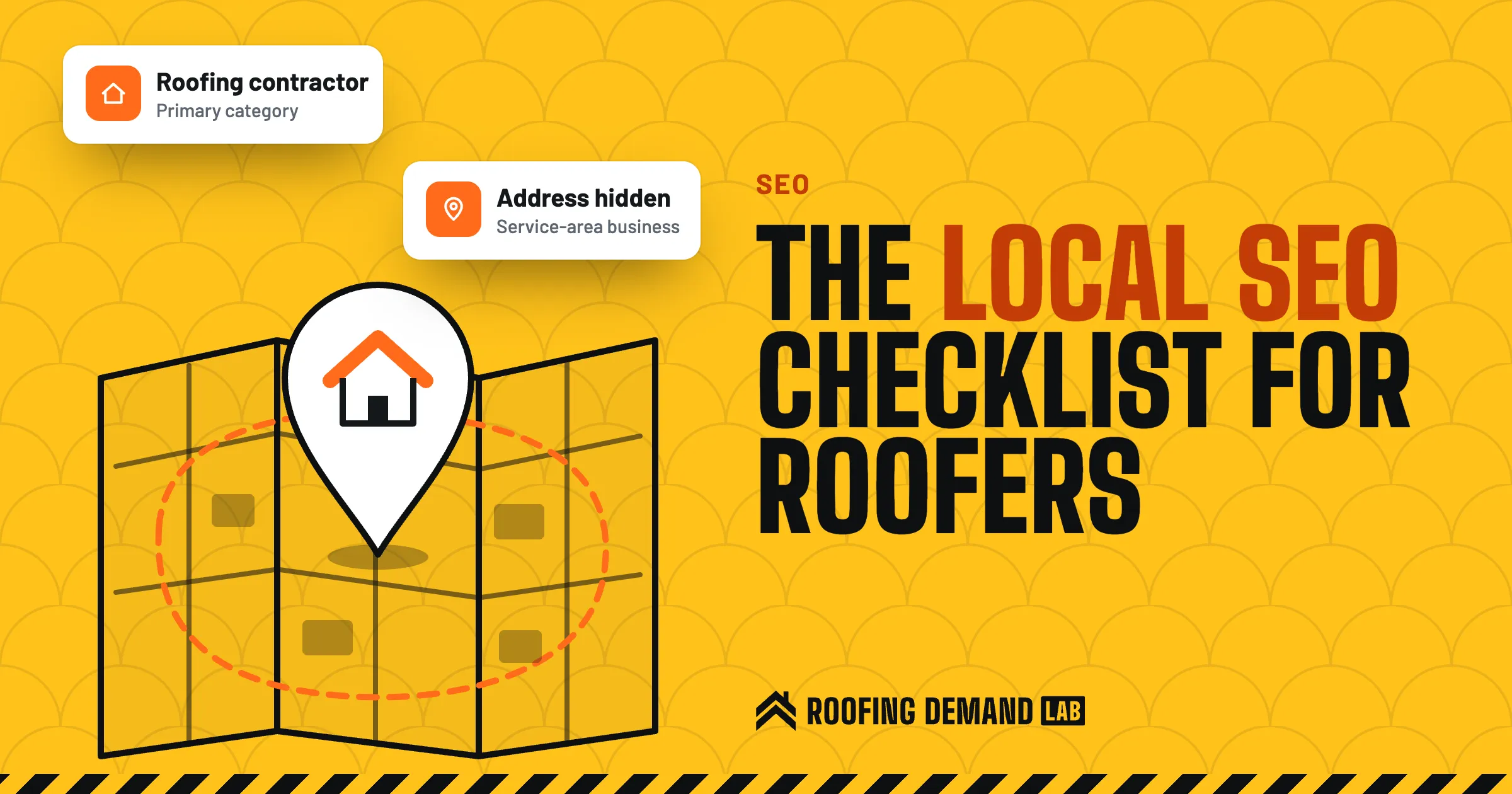
Most roofers go to the customer, which makes them a service-area business in Google’s eyes. Its guidelines say a service-area business “should hide your business address from customers.” The same page says P.O. boxes and mailboxes at remote locations aren’t acceptable, and that a rented mailing address where you don’t actually operate isn’t eligible for a profile.
Address rules
Don’t rent a virtual office in the next town over to get a pin there. Google’s guidelines rule it out, and the same guidelines say breaking them can get a profile suspended. Run the business from where it actually runs and use service areas to cover the rest.
4. Set service areas town by town
Google lets you list up to 20 service areas by city, postal code, or other area, but not as a radius around your shop, and it says the whole area shouldn’t stretch past about two hours of driving time from where you’re based (Google’s service area help page (opens in a new tab)).
Pick the towns you actually want work in, not every place you’d ever drive to. Padding the list won’t make up for distance.
5. Choose the category carefully, then list your services
Your primary category does a lot of the relevance work, and for most roofers it’s “Roofing contractor.” Google’s guidelines say to “use as few categories as possible” to describe your core business, so add secondary ones only if they honestly fit, like gutter work you really sell.
Then fill in the services list: roof replacement, roof repair, storm damage inspections, metal roofing, flat roofing, whatever you do. That’s where you match the specific searches homeowners type, which we broke down in our guide to roofing keywords.
6. Add real job photos, and keep adding them
“Add photos & videos” is on Google’s list of local ranking tips. Its photo guidelines ask for JPG or PNG files between 10 KB and 5 MB, recommend 720 by 720 pixels, and say a photo should be “in focus and well lit” and “represent reality” (Google Business Profile photo guidelines (opens in a new tab)).
Real is the point. Your trucks with the logo visible, crews tearing off, a finished ridge line, the dumpster in the driveway. Get the homeowner’s OK before posting anything that shows their house up close. Stock photos of a roof that isn’t yours do nothing for a homeowner trying to decide if you’re legit.
7. Ask every customer for a review
Google says “more reviews and positive ratings can help your business’s local ranking.” Reviews are also the first thing a homeowner reads on your profile, so this is the item that pays twice.
Two review rules
Ask everyone. Google’s policy says businesses may not “selectively solicit positive reviews,” and it bans incentives like payment, discounts, or free services in exchange for a review (Google’s policy on fake engagement and rating manipulation (opens in a new tab)). Separately, the FTC’s rule on fake reviews lets it seek civil penalties against businesses that knowingly buy or fake them (FTC announcement (opens in a new tab)).
Send the review link the day the job wraps up. Our roofing reviews guide has a full routine, from the signing appointment to a single follow-up.
8. Reply to reviews, good and bad
Google’s review help page says replying shows customers “you value their feedback” (Google’s guide to managing reviews (opens in a new tab)). “Respond to reviews” is also on its local ranking tips list.
Keep replies short and specific. Thank the five-star customer by mentioning the job (“Glad the new roof held up through last week’s storm”). For a bad review, stay calm, don’t argue the details in public, and offer to talk offline. The next homeowner reading it cares more about how you handled it than about the complaint.
9. Make your website agree with your profile
Your profile and your website should tell the same story: same business name, same phone number, same towns. Google’s tips include keeping your business information up to date, and a site that lists a different phone number or a town you dropped years ago makes that harder.
A few website basics feed local SEO directly:
- A unique title tag on every page. Google’s SEO Starter Guide says a good one is “unique to the page, clear and concise, and accurately describes the contents of the page” (Google’s SEO Starter Guide (opens in a new tab)).
- Your service area spelled out in plain text, not just in a map image.
- LocalBusiness structured data, which Google says lets you tell it about details like your hours. It’s worth adding, but Google also says it “does not guarantee” the search features that use it will show (Google’s local business structured data guide (opens in a new tab)).
- A link from your Business Profile to the matching page on your site.
If your site can’t do those, it’s working against the profile. That’s the reason every roofing website we build starts from this list.
10. Build town pages that are actually about the town
A page for each town you want work in can help you match “roof repair [town]” searches. It can also backfire. Google’s spam policies name “pages targeted at specific regions or cities that funnel users to one page” as an example of doorway abuse, and they treat churning out many pages mainly to manipulate rankings as scaled content abuse (Google’s spam policies (opens in a new tab)).
The difference is substance. A real town page shows jobs you did there, names the neighborhoods you work in, talks about the roof types and storms common in that area, and answers a question someone from that town would ask. A page where only the city name changes is the thing Google’s policy describes. Five real town pages beat fifty cloned ones.
Shortcuts that cost more than they save
Every item above has a faster version someone will sell you.
| The shortcut | What to do instead | |
|---|---|---|
| Business name | Add “Roof Repair” and your city to it | Use your real-world name only |
| Location | Rent a virtual office in a bigger town | Hide your address and set service areas |
| Reviews | Ask only happy customers, or offer a discount | Send the link to every customer, no rewards |
| Town pages | One template, 40 city names swapped in | Fewer pages with real local jobs and detail |
| Photos | Stock images of someone else’s roofs | Your own crews, trucks, and finished jobs |
Each shortcut on the left breaks a Google rule quoted above or gives a homeowner nothing to go on. The worst can get a profile suspended.
How long local SEO takes for a roofer
Some of this checklist shows up fast. Fix a category or a service area and Google may reflect it within days. Reviews and town pages build slowly, and in a market where a dozen roofers have years of reviews, it can take a long time to catch up. Google’s own SEO Starter Guide says some changes “might take effect in a few hours, others could take several months.”
Nobody can promise you a spot in the map results, us included. Google says as much. What the checklist does is remove the reasons Google might pass over your profile and give it more reasons to show you.
A simple rhythm keeps it going:
- Every job Photos before, during, and after. Review link the day you finish.
- Every week Reply to new reviews. Add a few photos to the profile.
- Every month Check that the profile, website, and listings still match. Add or improve one town or service page.
- Every quarter Recheck your service areas and categories against the work you actually want.
If you’d rather hand the whole list to someone, it’s what our roofing SEO work covers every month, and every plan includes it.
Questions roofers ask about local SEO
Why is local SEO important for roofers?
Homeowners with a leak or storm damage usually search for a roofer close by, and Google often answers those searches with a map of nearby businesses. Local SEO is the work that gives your company a shot at appearing there. It’s also mostly free, apart from your time or an agency’s fee.
How long does local SEO take for a roofing company?
Quick fixes like categories or service areas can show up within days. Reviews, photos, and town pages build over months, and competitive markets take longer. Google’s SEO Starter Guide puts the range for changes at a few hours to several months.
Can I rank in towns where I don’t have an office?
You can list them as service areas, up to 20, within about two hours’ drive of where you’re based. Distance still counts in Google’s local results, so you’ll usually have an easier time near your base. Real town pages with local jobs can help you show up in regular search results for those towns.
Do I need a website for local SEO?
You can have a Business Profile without one, but a website gives Google more to go on. It’s where your service pages, town pages, and structured data live, and many homeowners check it before they call. A site that matches your profile supports everything else on this checklist.