Business8 min read
Roofing Invoice Template: What to Put on the Final Bill
A roofing invoice template for the final bill: contract reference, line items, change orders, deposits credited, balance due, lien releases, and warranty.

In this article
A roofing invoice template is the form you fill in when the work is done (or a stage of it is) to tell the customer what they owe, why, and how to pay. The best final invoice holds no surprises. Every line on it already appeared on the estimate, the contract, or a signed change order. The only new number is the balance.
Most free templates online are a logo, a table of items, and a total. That works for a gutter cleaning. A roof replacement has a deposit to credit, maybe a decking change order, a lien release to hand over, and a warranty to explain. Below is the layout we’d start from, then what goes in each part. It’s general information, not legal or tax advice, so run your final version past your attorney and accountant.
The short answer
A roofing invoice should show your company details and license number, an invoice number and date, the customer and job address, the contract it bills against, the work completed, any signed change orders, every payment already received, the balance due, the due date, and how to pay. On the final invoice, add how lien releases and warranty papers will be delivered.
Estimate, contract, invoice: three papers, one job
Each piece of paper answers a different question, and they should agree with each other.
| Paper | The question it answers | When it goes out |
|---|---|---|
| Estimate | What will this cost? | After the inspection |
| Contract | What are we each agreeing to? | Before work starts |
| Invoice | What do you owe now? | At each payment milestone, and at the final walk-through |
If the invoice says something the contract didn’t, the homeowner calls you instead of paying you. Build the invoice from the contract, not from memory.
The roofing invoice template
Copy this into your accounting software, your roofing CRM, or a plain document, and replace the brackets.
| Section | What to fill in |
|---|---|
| Header | [Legal business name], [address], [phone], [email], [license number], [logo] |
| Invoice details | [Invoice number], [invoice date], [due date], [progress or final] |
| Customer | [Name], [billing address], [job address], [email] |
| Contract reference | [Contract or estimate number], [date signed] |
| Work completed | [Line items in the same wording as the contract] |
| Change orders | [Change order number], [date signed], [description], [amount] |
| Payments received | [Deposit, date, amount], [progress payments, dates, amounts] |
| Balance | [Contract price], [plus change orders], [minus payments], [tax if it applies], [balance due] |
| How to pay | [Accepted methods], [where to send it], [who to call with questions] |
| Closeout | [Lien release delivery], [warranty documents], [review link] |
How to fill in each part
1. Header and invoice details
Use the same legal name that’s on your license, contract, and insurance, plus your license number if your state asks for it on paperwork. Give every invoice its own number and mark it as a progress or final invoice. A homeowner holding “Invoice 2 of 3” knows exactly where the job stands.
2. Customer and contract reference
List the job address even when it matches the billing address. Then name the contract or estimate this invoice bills against, with the date it was signed. That one line ties the bill to a document the customer already agreed to.
3. Work completed
Copy the scope wording from the contract instead of rewriting it. If the contract said “tear off one layer to the deck, install synthetic underlayment and ice barrier, replace pipe boots and drip edge, install ridge vent,” the invoice says the same. A homeowner comparing the two papers should find matching lines, not a puzzle.
On a progress invoice, bill only the stage that’s finished. In California, the contractor board says payments to the contractor “cannot exceed the value of the work performed,” apart from a limited down payment (CSLB on home improvement contracts (opens in a new tab)). Other states have their own rules, so check yours.
4. Change orders
Give each change order its own line: its number, the date it was signed, what changed, and the amount. Extra decking sheets are the classic one. California requires a written change order “signed by the customer and contractor prior to the change” (CSLB (opens in a new tab)), and it’s a sound habit anywhere. If a charge has no signed change order behind it, it doesn’t belong on the invoice until you’ve talked it through with the customer.
5. Payments received and balance due
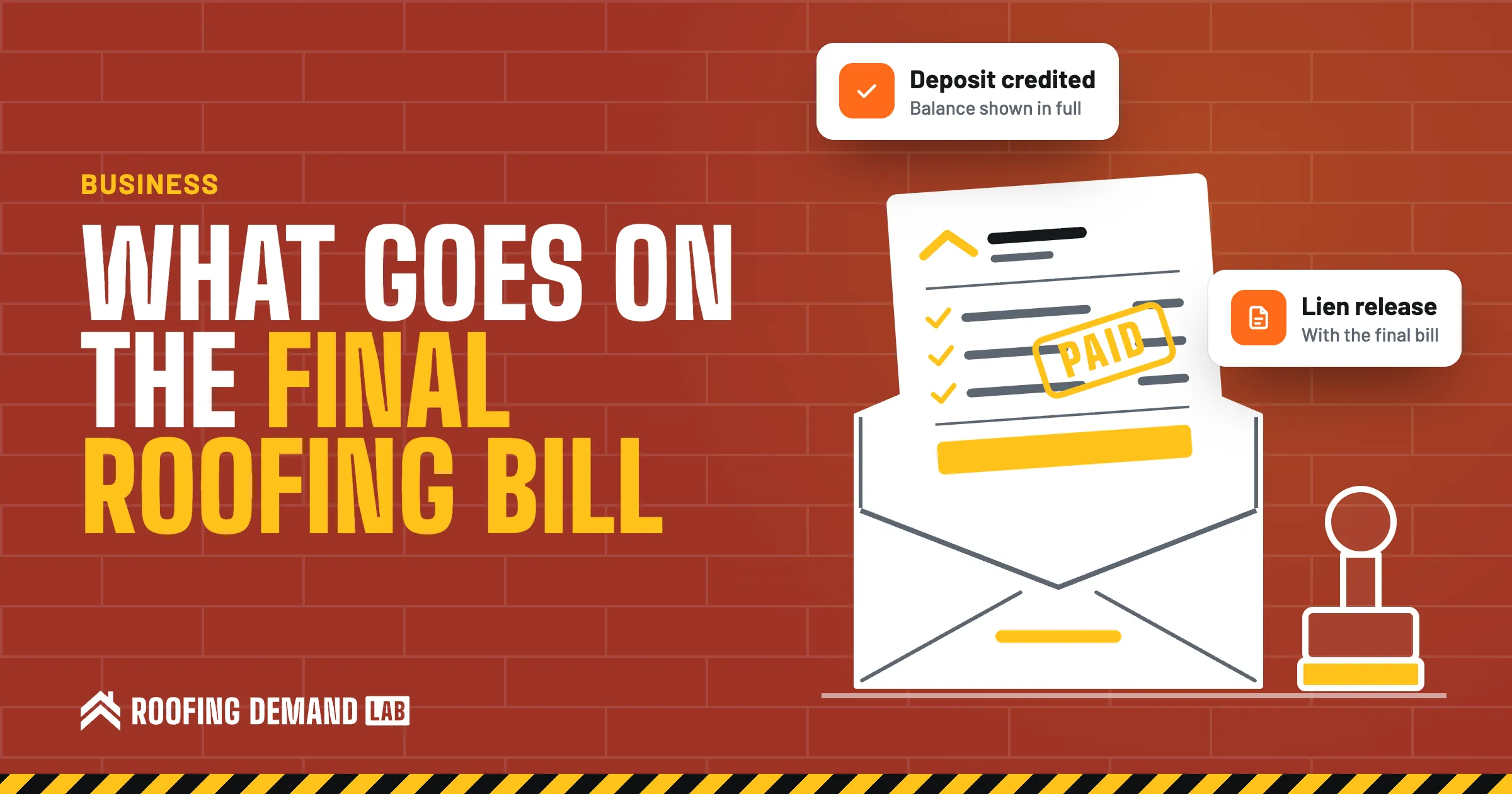
Show the math in full: the contract price, plus approved change orders, minus every payment already received with its date, equals the balance due. Leaving the deposit off, even for a day, can make an honest bill look like double billing.
Time the final invoice to the final walk-through. The Federal Trade Commission tells homeowners to “never make the final payment until the work is done and you’re satisfied with it” (FTC: how to avoid a home improvement scam (opens in a new tab)). Walk the property, check the cleanup, answer questions, and then hand over the final bill.
6. Due date and how to pay
Put a real due date on it, not “upon receipt,” and list the payment methods you take. Offer more than cash. The same FTC page (opens in a new tab) lists contractors who “only accept cash” among its warning signs for homeowners. Add one name and one email for billing questions, so a confused customer reaches a person instead of a voicemail box.
7. Lien releases
Homeowners worry about paying you and then getting a lien from your supplier. Say on the final invoice how and when they’ll get any lien releases.
Check your state’s lien rules
Lien release forms and timing are set by state law. In California, the contractor board publishes conditional and unconditional release forms for progress and final payments, and says a conditional release on final payment “is only binding if there is evidence of payment to the claimant” (CSLB lien release forms (opens in a new tab)). It also tells homeowners they may withhold the next payment until they get unconditional releases for the previous one (CSLB: how to prevent a mechanics lien (opens in a new tab)). Ask your attorney which forms your state uses and when to deliver them.
8. Warranty handoff
The final invoice is a natural place to list the warranty papers the customer is getting: the manufacturer’s material warranty and your workmanship warranty, kept separate. Don’t let the invoice be the first time they hear the terms, though. The FTC’s warranty guide says that in door-to-door sales, “you must offer the customer copies of the written warranties before the sale is completed” (FTC: businessperson’s guide to federal warranty law (opens in a new tab)). The invoice confirms what the contract already promised.
9. A thank-you and a review link
End with one line of thanks and your Google review link or QR code. Google says businesses “can ask customers to visit a Google link or scan a QR code” (Google Business Profile help (opens in a new tab)).
Two review rules
Put the same link on every final invoice, not only the ones for happy customers. Google’s policy bars businesses from offering incentives such as payment, discounts, or free goods or services in exchange for reviews, and from trying to “selectively solicit positive reviews from customers” (Google Maps content policy (opens in a new tab)). So no “$50 off when you leave a review” line on the bill.
Sending it and keeping copies
Email is the easy default. A message that only “facilitates, completes, or confirms a commercial transaction that the recipient already has agreed to” counts as transactional under the FTC’s CAN-SPAM guide, and is exempt from most of the law, though its routing information still has to be accurate (FTC CAN-SPAM guide (opens in a new tab)). Add a promotion to that email and it may stop being transactional, so keep invoice emails about the invoice.
If you’d rather text a payment link, get the customer’s consent first and note it in your records. FCC rules require consent before autodialed texts to a mobile number, and “commercial texts require written consent” (FCC on robocalls and texts (opens in a new tab)).
Keep a copy of every invoice, paid or not. The IRS lists invoices among the supporting documents a business keeps for its records (IRS: what kind of records should I keep (opens in a new tab)). Its general rule is three years, with longer periods in some situations (IRS: how long should I keep records (opens in a new tab)). Ask your accountant how long to keep yours, and whether sales tax belongs on your invoices in your state.
What to leave off a roofing invoice
- Charges nobody agreed to. If it isn’t in the contract or a signed change order, have the conversation first.
- Vague lines. “Labor and materials: [amount]” invites a phone call. Match the contract’s wording.
- Pressure. A late fee your contract allows is fine. Threats in a final notice are not.
- Anything that changes the story for an insurer. Bill the real price for the real work.
Insurance-claim jobs
States regulate how contractors handle roof claims. Florida bars contractors from offering a rebate, gift, cash, or “waiver of any insurance deductible” in exchange for a roof inspection or for filing a claim, and from giving a repair agreement on a claim without an itemized good faith estimate (Fla. Stat. 489.147 (opens in a new tab)). Never adjust an invoice to cover a deductible. Have your attorney review any claim-related wording for your state.
The invoice is the last thing they see from you
The homeowner who pays a clear final bill, gets the lien release and warranty papers, and sees your review link can mention you to a neighbor without a story about the bill. Good paperwork closes the jobs you have. Getting more of them is a different job: a website that shows your work, and a Google profile with steady, honest reviews. Our roofing SEO work handles the Google side, and every plan includes a website built for roofers.
Questions roofers ask about invoices
How do you do an invoice for roofing?
Start from the signed contract. List your company details, the invoice number and date, the customer and job address, the work completed in the contract’s own words, any signed change orders, and every payment already received. Then show the balance, the due date, and how to pay.
What should a contractor invoice include?
At minimum: your legal business name and contact details, the customer’s name and job address, an invoice number and date, the work billed, the amount due, and payment terms. A roofing invoice should also reference the contract, credit the deposit, and list any change orders. On the final bill, say how lien releases and warranty documents will be delivered.
What’s the difference between a roofing estimate and an invoice?
An estimate tells the homeowner what the job will cost before they agree to it. An invoice tells them what they owe now, for work that’s done or for a milestone the contract sets. The two should match line for line, plus any signed change orders.
How long does a contractor have to submit an invoice?
No single rule covers every job. Your contract’s payment schedule should say when each invoice goes out, and some deadlines tied to payment, like lien filing windows, are set by state law, so ask your attorney. Sending the final invoice at the walk-through, while the job is fresh, is a good habit.